
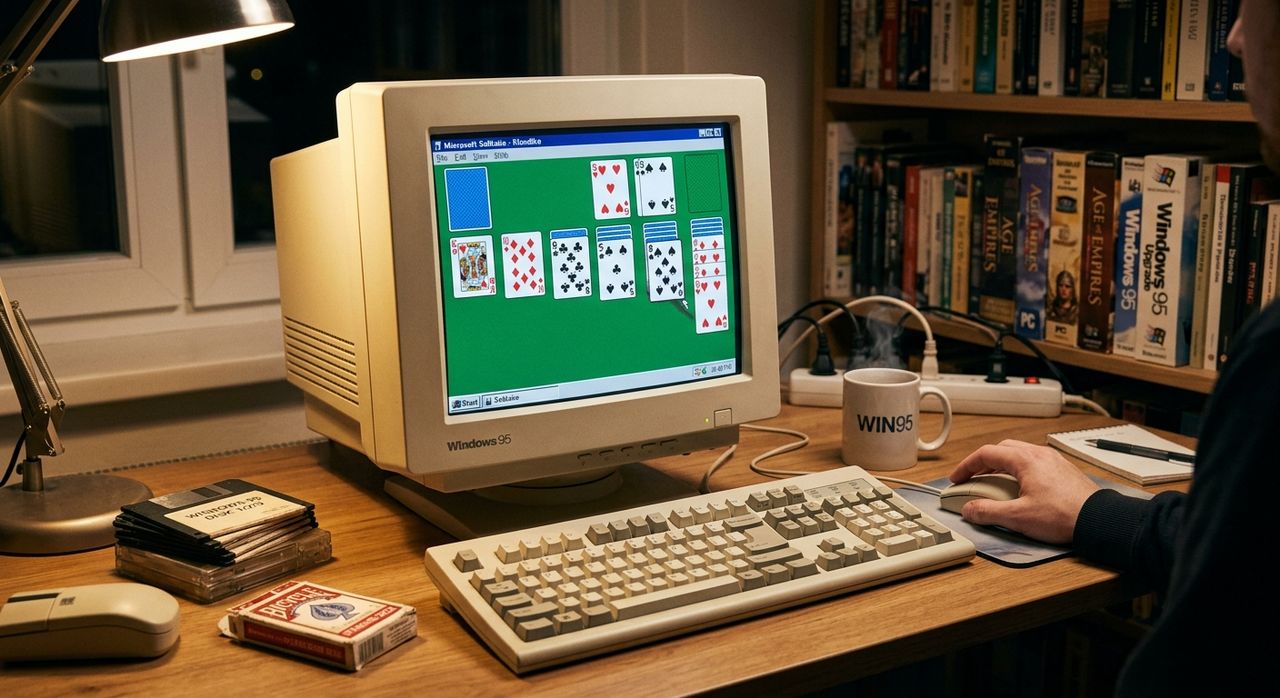
It arrived with no fanfare, no box art, and no marketing budget. Just a green felt background, a shuffled deck, and a cursor waiting to be dragged. When Microsoft shipped Solitaire with Windows 3.0 in 1990, most people assumed it was a throwaway filler app. They were wrong. It quietly became the most-played computer game in history, and almost nobody was supposed to know they were even playing it.
Key Takeaway: Microsoft bundled Klondike Solitaire with Windows 3.0 in 1990 as a practical training tool to help new PC users get comfortable with mouse gestures. It worked so well that it stuck around for decades, becoming a global phenomenon without any of the fanfare attached to blockbuster titles. Today the classic still draws players, and variants like Yukon offer a satisfying next step for anyone who has outgrown the original.
A Mouse Tutorial in Disguise
In 1990, the mouse was still a strange and unfamiliar device to most office workers. Computers had been keyboard machines. The idea of moving a physical object across a desk to control something on screen felt counterintuitive, and Microsoft knew it.
Wes Cherry, a summer intern at Microsoft, coded the original Microsoft Solitaire as a personal project and it caught the attention of the Windows team. Susan Kare, the designer famous for the original Mac icons, contributed the card artwork. The game shipped with Windows 3.0 as a deliberately disguised lesson in mouse operation.
Every action in Solitaire required a specific mouse skill:
- Pointing and clicking to select a card
- Dragging to move a card from one column to another
- Double-clicking to send a card to a foundation pile
- Right-clicking in later versions to access hints and options
Nobody had to sit through a tutorial video or read a help document. They just played cards. By the time they felt stuck and reached for the mouse to try another move, the lesson had already landed. It was one of the most effective pieces of user onboarding ever made, and it never advertised itself as such.
The Game Nobody Admitted to Playing
The genius of bundling Solitaire with Windows was the plausible deniability it offered.
If your boss walked past your desk and your screen showed a spreadsheet, you looked productive. If it showed a card game, you had some explaining to do. But Solitaire sat in the accessories folder, technically a productivity-adjacent tool, and the low resolution of early monitors made it easy to minimize in a hurry.
Office workers across the world played millions of hands. Not at home, not at gaming cafes. At work. During lunch breaks, between meetings, during conference calls nobody wanted to be on. The game spread through corporate America and then through Europe and beyond, carried along on every Windows license sold to every business running office machines.
There was never a marketing campaign. There was never a review in a gaming magazine. The numbers came purely from distribution.
How the Numbers Got Enormous
To understand how Microsoft Solitaire became the most-played computer game in history, you have to think about scale differently than you would with a console title.
A game like Doom or Street Fighter II could sell millions of copies through retail. That was remarkable. But Solitaire shipped with the operating system, which meant it reached everyone who bought a Windows PC, not just the people who specifically wanted to play a game.
Here is what that looked like in practice:
- Windows 3.0 launched in 1990 and sold roughly 10 million copies in its first two years.
- Windows 95 pushed that scale dramatically further, with 40 million licenses sold in its first year alone.
- By the time Windows XP launched in 2001, Microsoft was licensing Windows to hundreds of millions of machines worldwide.
- Solitaire shipped on every single one of them.
By some estimates, Microsoft Solitaire has been played by more than a billion people over its lifetime. No game sold through traditional retail channels has ever come close to those numbers, because no retail game ever had that kind of mandatory distribution.
What Made Klondike So Persistent
Klondike is the variant most people picture when they hear the word solitaire. Seven columns of cards, four foundation piles, a stock pile to draw from. The rules take about two minutes to learn.
That accessibility was the whole point. But accessibility alone does not explain why people kept coming back for three decades. There are a few other factors at play.
The game has an inherent tension between luck and skill. You cannot win every hand, and you know it. A bad shuffle will beat you no matter how clever your moves are. But a good player will win more often than a poor one, because there are real decisions to make at every step. That combination keeps the game from feeling like a slot machine or a chess match. It lands in a sweet spot that a lot of people find genuinely satisfying.
The short session length matters too. You can finish a game in five minutes or stretch it out if you get a tricky layout. It fits naturally into gaps in the day, which is exactly why it thrived in the office environment where it first spread.
Stepping Up From the Classic
For players who grew up on the Windows version and want something that uses the same skills but pushes them a bit harder, yukon solitaire is the natural next challenge.
The setup looks familiar at first. You still have seven columns and four foundation piles. But Yukon deals all 52 cards face-up from the start, with no stock pile to draw from. Every card is visible, which sounds like it should make the game easier. It does not.
Because there is no draw pile to bail you out, every move you make either opens up new possibilities or closes them off permanently. The game rewards careful planning and punishes impulsive play in a way that Klondike simply does not. Players who have spent years on the original version often find Yukon a refreshing reset, a game that feels familiar in structure but demands a completely different approach to win consistently.
The variant has been popular in physical card form long before any computer version existed, which gives it an authenticity that some of the more obscure digital-only formats lack.
The Desk Drawer Era
There was a time when every office had a physical deck of cards somewhere. In the break room, in someone's bottom drawer, in the cabinet next to the conference room supplies. Card games were a lunch-hour ritual before personal computers arrived on every desk.
The Windows version of Solitaire did not replace that ritual. It digitized it and scaled it up. But something about the physical version still appeals to people, especially those who want to step away from a screen for a while.
That is part of what makes printable solitaire feel like a callback to that era. You print a layout, grab a pen, and play the same game without any device involved. It sounds old-fashioned, and it is. That is the point. For people who spent formative years playing cards at their desk before anyone thought to put the game on a computer, there is something grounding about returning to the paper version. No notifications, no battery to watch, no minimize button to panic about.
The Card Game That Never Really Left
Microsoft removed Solitaire from Windows 8 as a default install and immediately heard about it. The outcry was significant enough that the company brought it back as a free app, and it has stayed available ever since. More than three decades after Wes Cherry wrote it as an intern project, the game still ships with Windows.
That kind of longevity does not happen by accident. It happens because the game actually works. It taught a generation of office workers how to use a mouse. It filled a billion lunch breaks. It became the backdrop for phone calls nobody wanted to take and afternoons that stretched a little too long.
No other card game has done what Klondike Solitaire did. No other computer game has reached so many people with so little effort on anyone's part. It just sat there on every Windows machine, waiting to be clicked, and people clicked it.
That is a better story than any marketing campaign could have written.
Leave a Comment