
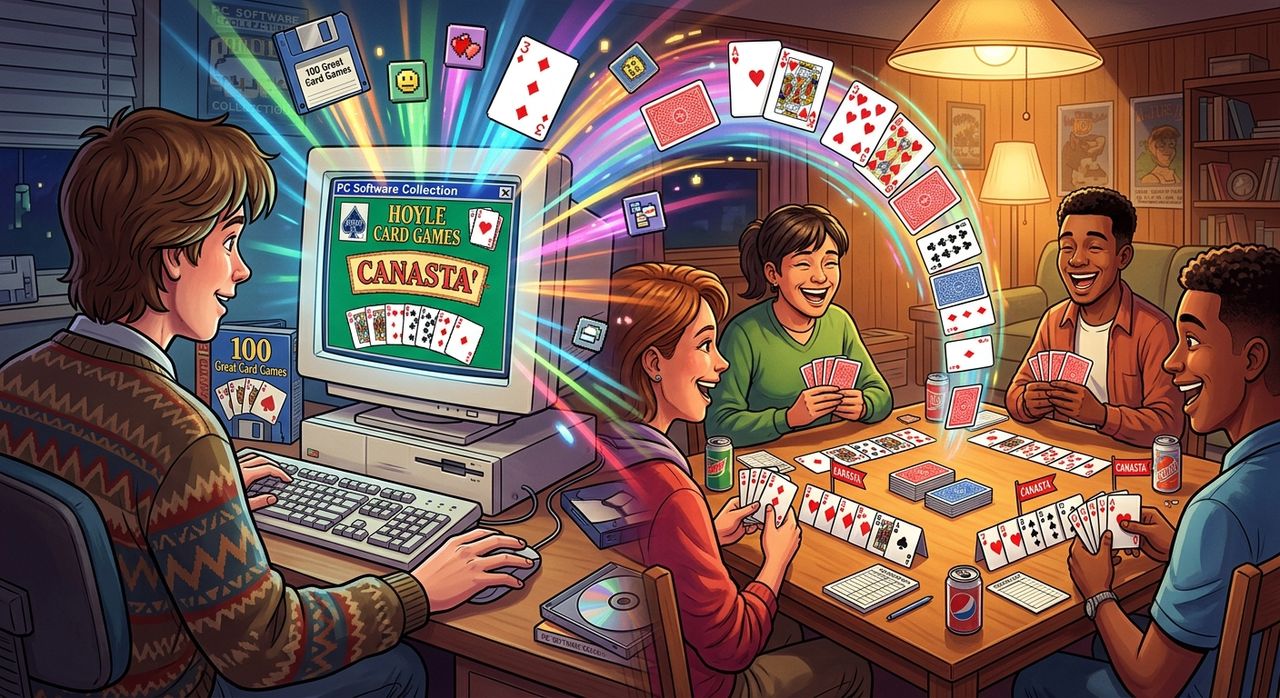
Long before streaming tutorials and app stores, millions of people learned card games from their computers. Not from the internet, but from a disc that came in the box with their new PC, or from a bargain-bin CD labeled "300 Games!" that sat next to the keyboard for years. These bundled software collections were more than entertainment. They were an accidental archive of card game culture, and canasta was one of the biggest beneficiaries.
Key Takeaway:
- Bundled PC card game collections of the early 1990s introduced canasta to millions who had no other way to learn it.
- Hoyle Card Games and Sierra's software set the standard for authentic, rules-faithful digital card games.
- The two-player format made canasta especially well-suited for solo play against a computer opponent.
- Shareware CD compilations spread these games far beyond retail buyers.
- Reference cards and printed cheat sheets were a standard companion to complex card games on early PCs.
The Era When Software Came in a Box
Think back to the early 1990s. A new PC cost the equivalent of several thousand dollars today, and it arrived with a stack of floppy disks or, slightly later, a CD-ROM. Manufacturers and retailers wanted to make the machine feel worth the investment, so they bundled software. Games especially. Card games were a natural fit: low system requirements, broad appeal, and they filled hours without demanding a fast processor or a hefty graphics card.
The practice created something unexpected. Games that had faded from living rooms, games that grandparents played but parents had forgotten, suddenly had a second life on glowing monitors in home offices and dens. Canasta was exactly that kind of game. It had been a sensation in the 1950s, spread by word of mouth across living rooms and country clubs, and then slowly receded. The PC brought it back through an entirely different door.
Hoyle Card Games and the Gold Standard
Sierra Entertainment was already famous for its adventure games when it attached the Hoyle name to a line of card game software. That was a deliberate choice. Hoyle referred to a centuries-old tradition of standardized card game rules, and Sierra used that association carefully. The result was a series that felt legitimate in a way that most budget software did not.
The Hoyle Card Games titles were thorough. They didn't just implement the basic rules. They included animated opponents with distinct personalities, in-game hints, and rule summaries you could pull up mid-hand. For a teenager sitting alone at a computer with no idea what a meld was or why wildcards mattered, that was everything. The game taught you as you played, and you could pause, read, and try again without anyone watching.
What Made the Hoyle Approach Work
The Hoyle series got several things right that other card game software of the era fumbled:
- Animated characters gave opponents a sense of personality, making solo play feel less mechanical.
- Integrated rule explanations meant you didn't need to keep the manual open beside you.
- Multiple difficulty levels let beginners learn without being crushed by expert AI.
- The visual card table aesthetic matched what people expected from a physical game.
Other publishers tried to compete, but the Hoyle formula proved hard to beat. It treated card games as something worth doing well, not as filler content dropped onto a disc to pad a feature list.
Shareware Discs and the 500 Games CD
Alongside Hoyle, there was an entire secondary market of shareware compilations. These were the CDs sold at gas stations and department store checkout counters, usually packaged in a thin cardboard sleeve with "500 Games!" or "1,000 Classic Games!" printed on the back. The software inside ranged from genuinely polished to barely functional, but the sheer variety meant something always stuck.
Canasta, with its complex scoring system and multi-phase gameplay, appeared frequently in these compilations. It was a prestige inclusion, the kind of game that made a disc feel like it offered real depth. Players who might have dismissed it at first, put off by the rules, would eventually load it up on a rainy afternoon and find themselves drawn in. The computer asked nothing of them but a click.
The shareware model also meant these games circulated through school computer labs, small businesses, and church offices in ways that retail titles never could. A single disc could introduce dozens of people to canasta who would never have sought it out on their own.
Why Canasta Fit the Computer Format So Well
Canasta has a reputation for complexity, and that reputation is earned. The scoring is layered, wildcards interact with the meld rules in ways that take time to internalize, and partnership play adds a communication dimension that makes the game richer but also harder to teach. At the kitchen table, that complexity meant canasta often got passed over in favor of rummy or gin. Nobody wanted to be the person explaining the rules for forty minutes before the first hand was dealt.
The computer removed that friction entirely. The software handled the scoring automatically. It flagged illegal plays. It reminded you when you could go out. You could take as long as you wanted between turns without making someone else wait. And if you made a mistake, the game simply corrected you rather than embarrassing you in front of family.
For solo play in particular, two-handed canasta hit a sweet spot. The two-player format strips the game down to its core mechanics, removing the partnership layer and putting the full decision tree directly in front of you. It's faster than the four-player version and easier to learn, which made it the natural starting point for anyone who loaded up a card game collection and clicked on canasta for the first time. Computer opponents in the two-player version were also more tractable to program well, which meant the AI felt fair and challenging rather than random or arbitrary.
Classic Card Game Software Side by Side
Software | Publisher | Canasta Included | AI Quality | Rule Explanations |
Hoyle Card Games (1991) | Sierra On-Line | Yes | High | Excellent |
Hoyle Classic Card Games | Sierra On-Line | Yes | High | Good |
Card Sharks (1992) | Accolade | Limited | Medium | Basic |
500 Games Compilation | Various publishers | Sometimes | Low to Medium | Minimal |
Windows Entertainment Pack | Microsoft | No | N/A | N/A |
The Hoyle series consistently led on both AI quality and player education, which is why it became the reference point for the genre and the version most people remember when they think back on learning card games from a PC.
The Laminated Sheet Next to the Keyboard
Anyone who played complex card games on early PCs remembers the reference materials. Some games printed fold-out cards that came in the box. Others had you printing pages from the manual. Some players made their own, handwriting scoring charts and meld requirements on index cards taped to the monitor bezel.
It was a practical habit born from necessity. Screen real estate in 640x480 was precious, and you couldn't keep a help window open while playing. So you kept a cheat sheet nearby. For canasta specifically, the scoring table was the thing people most needed: black threes, red threes, natural canastas, mixed canastas, going out bonuses. Getting those numbers wrong ruined a hand, and the software didn't always make it easy to look them up mid-game.
That instinct to keep a physical reference nearby hasn't gone away. A good printable canasta scoring sheet fills exactly the same role now as those laminated sheets did in 1993, whether you're playing online, teaching someone at an actual table, or just refreshing your memory after a long gap. It's one of those pieces of gaming infrastructure that the digital age never fully replaced.
The Players Those Discs Left Behind
Here's something worth sitting with. A lot of people who learned canasta from a PC in the 1990s never learned it from another person. They never had a grandmother teach them, never sat around a holiday table picking up tricks from older relatives. The software was their only teacher.
That's a different relationship with a game than most people think about when they get nostalgic for classic card games. The kitchen table origin story is real for some players, but for a large chunk of a generation, the origin story is a beige tower PC, a CRT monitor, and a card game compilation that came free with a printer.
- These players often know the rules precisely, because the computer enforced them strictly with no family variations or house rules baked in.
- They tend to be comfortable playing solo because that's how they started, and that comfort transfers naturally to computer opponents today.
Neither of those things is a drawback. They're just a different kind of card game education, one shaped by software rather than by people.
What the Software Collections Actually Preserved
It's easy to frame bundled software as a minor footnote in gaming history, a collection of filler titles included to justify a purchase price. But the card game collections did something more durable than that. They kept alive a set of games with real staying power, games with depth, games that rewarded attention and memory, games that people returned to again and again.
Canasta peaked in American popularity in the early 1950s, briefly outpacing even poker and bridge before gradually retreating from mainstream culture. By the 1980s it was kept alive mostly by dedicated clubs and older players. The PC software collections caught it just before it might have slipped away entirely from the popular consciousness, and they handed it to a new generation in a form that generation could actually access.
That's not a small thing. Software preservation conversations usually focus on games as artistic objects, the stories and the aesthetics. But for card games, the software preserved something older and more fundamental: the rules, the rhythms, and the specific pleasure of a well-played hand.
The Discs That Dealt Canasta a New Hand
If you grew up in the 1990s and you know how to play canasta, there's a reasonable chance a PC taught you. Not a textbook, not a grandparent, not a video. A game that came bundled on a disc or downloaded from a shareware BBS, running on hardware that cost more than a used car and sounded like a vacuum cleaner warming up.
Those collections deserve more credit than they usually get. They weren't just bundles of filler. They were a transmission mechanism for a kind of cultural knowledge that looked like it might be fading, and they delivered it in exactly the format that a new generation of players could receive. The kitchen table version of canasta survived inside those software collections, waiting for someone to click on it.
The game itself held up. That's the part that always surprises people who return to it after years away. The rules are still just as interesting, the decisions are still genuinely hard, and the satisfaction of closing out a hand with a well-timed natural canasta feels exactly the same whether you're playing on a 486 or a modern browser. The software didn't save a dying game. It saved a great one.
Leave a Comment