
Something has been quietly shifting inside retro PC gaming communities over the past couple of years. Scroll through any fan wiki for a classic DOS title, browse the submission queue of a site dedicated to early Windows strategy games, or check the forums where people share retrospectives on shareware FPS games from the early 90s. You'll start noticing pieces that feel strangely hollow. The sentences are clean. The structure is solid. But there's no soul. No memory of booting a game from a floppy disk at midnight, no specific frustration with a puzzle that never made sense, no lived experience anywhere in the text. These are AI-generated pieces, and they're making it harder for editors, readers, and the writers themselves to know who to trust.
Retro gaming communities built on personal knowledge are now dealing with a flood of AI-generated submissions that undercut the credibility of genuine writers.
- AI tools can produce plausible-sounding content about almost any game, including titles they have never played
- Editors at retro gaming sites are increasingly skeptical of submissions, even from writers with real histories in the space
- Running your own draft through an AI detection tool before submission has become a practical credibility move, not a sign that something is wrong
Why the Retro Gaming Scene Is Especially Exposed
The titles that retro PC gaming writers cover don't get massive mainstream press attention. That's part of what makes the community valuable. A walkthrough for a 1993 dungeon crawler or a retrospective on a mid-90s shareware RPG exists because someone genuinely sat with the game and remembers it. Readers trust these pieces precisely because no mainstream outlet covered the game in depth.
That same quality makes the space vulnerable. When AI-generated content floods a niche, it doesn't just pollute the information. It erodes the foundation of community trust that makes the niche worth reading at all.
Large language models have processed enormous amounts of gaming content from across the internet. They can generate structurally coherent guides to DOS-era games that sound reasonable on the surface. The problem is that they often get subtle details wrong, describe mechanics in ways that feel vague, and produce text with none of the personal context that defines good retro gaming writing.
The retro PC gaming world has long operated on voluntary contribution and shared expertise, much like the broader abandonware preservation community that works to keep old software accessible. When readers can't distinguish genuine enthusiasm from generated text, that model starts to crack.
What Editors Are Starting to Notice
Editors who run retro gaming publications are now doing something they never had to do before: actively screening submissions for AI generation. Some are doing it openly, mentioning it in their contributor guidelines. Others use detection tools quietly before sending feedback. Either way, the bar for new contributors has shifted.
The signals they look for have become well-known within editorial circles:
- Writing that describes a game's mechanics in aggregate but misses the specific texture of how they actually feel to play
- Sections that are oddly comprehensive, covering every corner of a game with equal confidence, where a real writer would admit gaps in their memory
- No hedging, no "I think this was different in the demo version," no acknowledgment of personal uncertainty
- Structure that mirrors generic blog post templates rather than the natural flow of someone telling their history with a game
- Language that is smooth but impersonal, without the quirks and side observations that give a writer a recognizable voice
Human Writing vs. AI-Generated Content in Retro Gaming Submissions
Characteristic | Human-Written Piece | AI-Generated Piece |
Accuracy on obscure details | Occasionally gaps, usually acknowledged | Appears complete but can be subtly wrong |
Personal voice | Present throughout | Absent or simulated |
Hedging and uncertainty | Natural and appropriate | Rare or missing |
Coverage of game mechanics | Specific and experiential | Generic and descriptive |
Memory gaps acknowledged | Common | Almost never |
Structure | Reflects the content and story | Follows template patterns |
This comparison maps the specific things editors now run through their heads when reading a submission from an unfamiliar contributor.
Why Honest Writers Get Caught in the Crossfire
Here's the uncomfortable part. A writer who has spent years covering retro PC games can suddenly find their work scrutinized in ways it never was before. Editors who know you personally are fine. But pitch a new site, contribute to a wiki you haven't written for before, or submit to a community hub where the editors don't know your history, and your work might get flagged simply because it reads cleanly.
That isn't fair. But it is the current reality, and working around it requires a change in process rather than a change in how you write.
Running Your Own Content Through Detection Before You Submit
The practical response to this situation isn't to write worse on purpose. It's to self-verify before sending your work out.
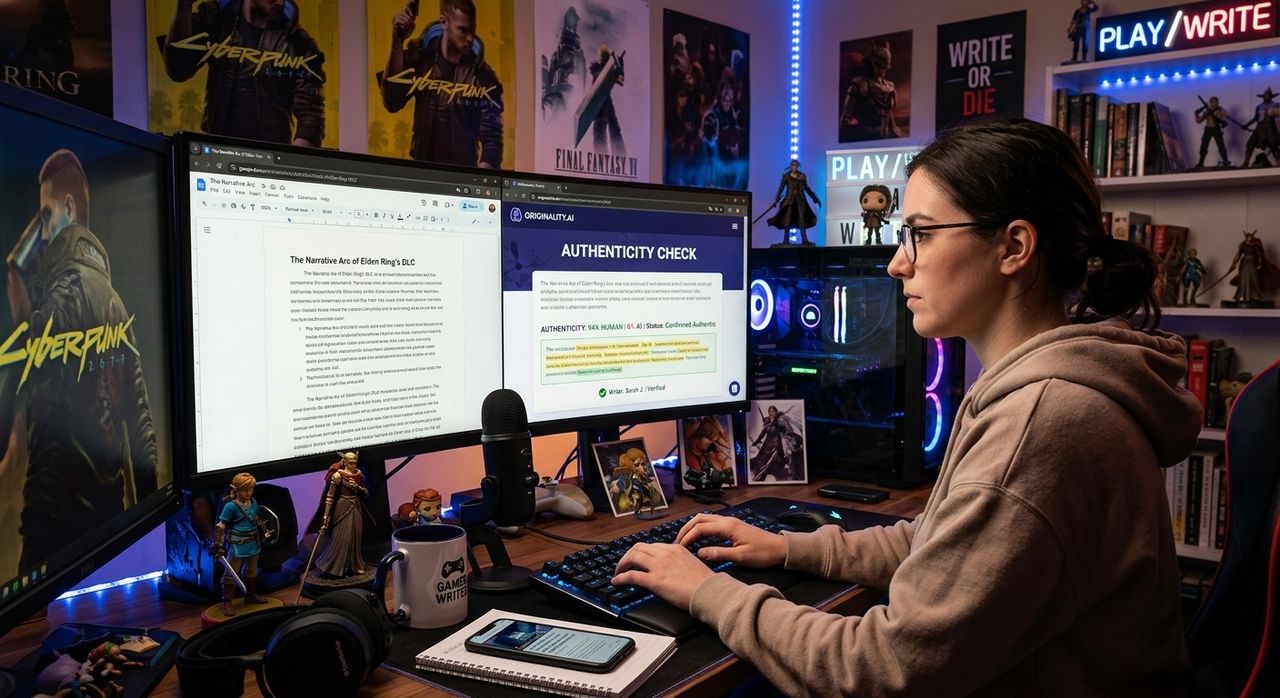
Running your own draft through an AI checker before submission has become a professional habit for writers who take their reputation seriously. The logic is straightforward. If your work passes a detection check, you have something concrete to mention if an editor asks about it. If a section flags unexpectedly, you have a chance to look at it again before anyone else sees it.
This isn't about proving anything to a machine. It's about having a professional process that shows you care about the authenticity of what you're putting out. Think of it the way a retro game reviewer approaches a piece they've already drafted. Going back through the notes, double-checking the facts, making sure the published article reflects actual experience rather than a rough first pass. It's quality control applied to a different kind of authenticity.
Building the Self-Check Into Your Writing Routine
Making detection checks part of your routine doesn't require a major overhaul. Most writers find it fits naturally at the end of the drafting phase, before final editing.
Write your draft from personal notes and memory as you normally would. Do your first editing pass for clarity and flow. Once the draft feels solid, run it through a detection tool and review any flagged sections. If something flags, reread that section yourself and ask honestly whether it sounds like you or whether you drifted into generic territory while tired or rushing. Make any adjustments, then do your final edit before submission.
The goal isn't to hit a specific score. It's to use the output as a mirror. Sometimes a flagged section is just a list of facts that happens to pattern-match with AI output. A rewrite in your own voice usually resolves it. Other times, a flag points to a section where you reached for generic language without realizing it. That's valuable feedback you'd otherwise miss before an editor sees it.
Editors notice when contributors mention this step unprompted. It signals awareness of the current climate. More importantly, it signals that you take the work seriously enough to self-audit before anyone else is involved.
The Credibility That Retro Gaming Writing Depends On
The whole reason people read retro PC gaming content, rather than consulting a database, is the human layer. They want someone who remembers whether the shareware version of a game had a different ending. They want the writer who spent an afternoon comparing the DOS and Windows versions and noticed the music sounded different. They want the perspective of someone who was actually there, even if "there" was a bedroom in 1994 with a 486 and a stack of floppy disks.
That human layer is what makes the community worth being part of. And protecting it isn't paranoia. It's craft.
Writers who build verification into their process aren't signaling doubt about their own work. They're signaling that they understand what the work is for, and that they respect the readers and editors who depend on it being genuine. In a scene that has always run on trust, that matters more than ever.
Leave a Comment