
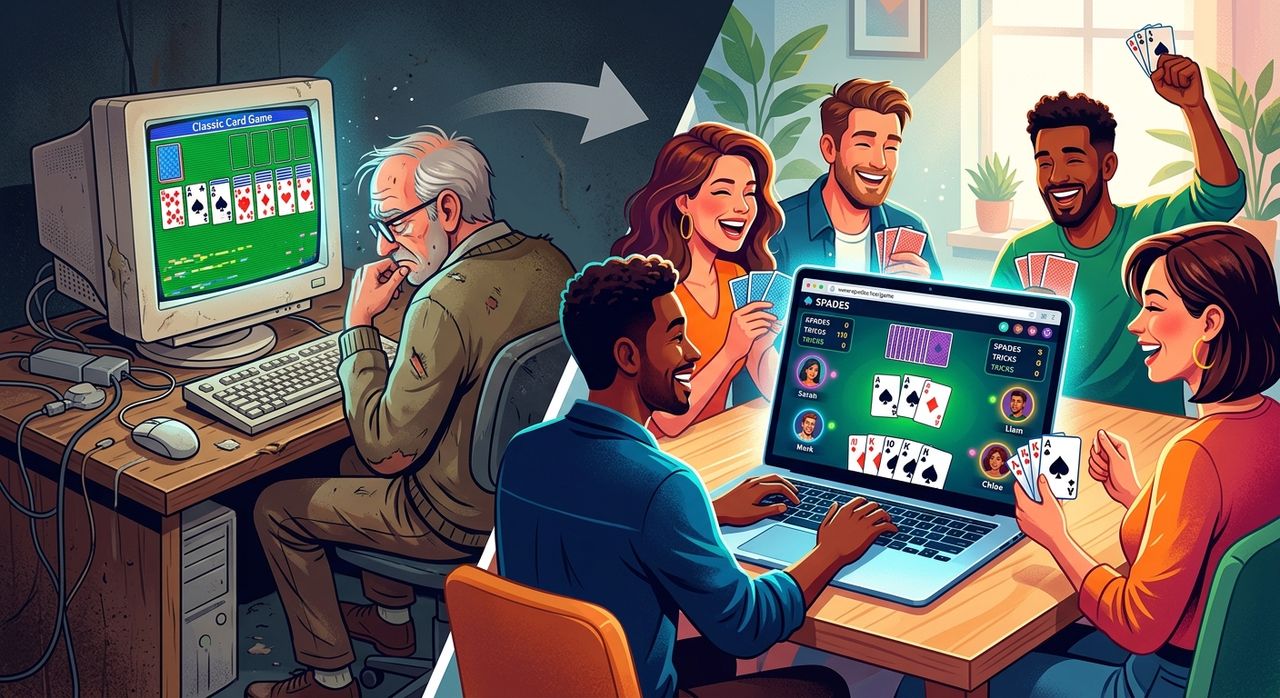
Windows gave us Hearts. Windows gave us Solitaire. But the one card game that ruled every LAN party basement, every dorm computer lab, and every late-night multiplayer session in the late 1990s, Windows never actually shipped. That game was Spades. For anyone who lived through that era of beige towers and 56k modems, that absence still feels like a strange oversight. Browser-based Spades is finally filling the void, and the retro PC gaming crowd is paying close attention.
Why This Matters: Windows 95 and 98 bundled Hearts and Solitaire as pack-in games, but Spades, the card game that defined LAN party culture, was conspicuously absent from the operating system. Browser-based versions are now giving retro PC gamers the experience they always wanted, with the competitive depth that made Spades so addictive in the first place. If you remember counting bids at a college computer lab, this is for you.
The Pack-In Games Microsoft Forgot
The bundled card games on Windows 95 and 98 were a masterstroke of casual game design. Solitaire was originally added to teach users how to drag and drop with a mouse. Hearts was included to teach networking concepts through local multiplayer. Both worked beautifully as subtle tutorials wrapped in familiar formats.
Spades got none of that institutional backing, which is odd given how popular it already was. Walk into any college dorm in 1997 and you would find Spades being played on someone's Gateway 2000, usually through a third-party freeware package downloaded over a painfully slow connection.
The game had all the ingredients that made the bundled titles successful. It was easy to learn, endlessly replayable, and genuinely strategic. But without Microsoft's blessing, it lived in the margins, passed between friends on floppy disks and early CD-ROM compilations.
What Made Spades the LAN Party Standard
Spades thrived in exactly the environment that late-90s PC gaming created. LAN parties, where friends hauled their tower PCs to someone's garage and connected via ethernet cables, were a defining social ritual of that generation. The downtime between rounds of Quake or Age of Empires needed filling, and Spades was always ready.
The card game Spades) traces its roots to the American Midwest in the 1930s, but it found a second life in the early PC era precisely because it was built for competition. Every player bids at the start of a round, committing to a number of tricks they plan to win. Underbid and your team gets penalized. Overbid and you collect bags that slowly drag your score down.
A few mechanics made Spades especially dangerous at a LAN party table:
- The bidding system forced every player to commit publicly before a single card was played, creating immediate psychological pressure
- Spades as a suit are always trump, meaning no round plays out the same way twice
- Sandbag penalties punished overly conservative play, so turtling your way to victory was never really an option
Those rules rewarded memory, opponent-reading, and calculated risk. That structure mapped perfectly onto the zero-sum mentality of competitive gaming at the time.
The Every-Player-For-Themselves Format
Standard Spades is a partnership game. Two players team up against two others, and the shared bid system creates a cooperative layer that smooths out individual mistakes.
Cutthroat spades throws all of that out. In this format, every player bids and plays entirely for themselves. There are no partners, no shared goals, and no one to blame for a bad round but yourself. If you bid four tricks and only take three, you eat the penalty alone. If you nail your bid while the other players bust, you pull ahead cleanly.
It is ruthless, and it is very hard to put down.
For retro PC gamers who remember the zero-sum intensity of early multiplayer gaming, cutthroat Spades hits exactly the right nerve. The format strips away the diplomatic softness of partnership play and replaces it with the kind of direct competition that defined that era. No teammates to rely on. No shared blame. Just your own bids, your own cards, and your own results.
Why Browser Play Works So Well for This Crowd
The retro PC gaming community has always had a complicated relationship with modern software. Many players in this space are deeply attached to older formats, older hardware, and older design philosophies. At the same time, the practical barriers to running old software keep growing. Compatibility layers fail. Drivers disappear. Physical media degrades.
Browser games sidestep most of those headaches entirely. There is nothing to install, no compatibility check to run, and no concern about whether the game will open on your current operating system. You load a page and you play.
That accessibility matters especially for card games, where the core experience has not changed in decades. Spades in a browser plays identically to Spades on a floppy disk, because the rules have not moved. What the browser version adds is convenience, availability, and in most cases a more polished interface than anything the shareware era ever delivered.
The Features That Make Modern Browser Spades Worth Playing
The better browser Spades implementations have also learned from the design lessons of classic PC games. They do not pad the experience with unnecessary menus or force account creation before you can touch a card. They get you into a game fast, which was always the standard the shareware era set.
Here are some of the features that stand out for players coming from a retro background:
- Variant support that goes beyond standard partnership rules, covering formats like solo, whiz, and mirror Spades so you are not locked into one style
- Adjustable difficulty against computer opponents, so you can ease back in gradually or immediately test yourself at a level that actually pushes back
- Clean interfaces that feel closer to a card table than a mobile app, without the cluttered design trends that plague casual gaming today
Those qualities matter to a crowd that grew up appreciating functional design over decorative excess. The shareware card games of the 1990s were not beautiful. They were clear, fast, and respectful of your time.
A Refresher for Players Who Last Read a Card-Game Manual in 1999
One thing the late-90s shareware era did well was documentation. Most card game packages from that period came with a help file or printed manual that walked you through every rule and term. If you bid a Nil, the game explained exactly what that meant and what happened if you failed it.
For anyone who last encountered terms like bags, blind Nil, or sandbag penalty in a yellowed instruction pamphlet, spending five minutes with a good terminology reference before sitting down for a serious session is genuinely worthwhile. The vocabulary has not changed, but the rust is real after a twenty-year gap.
The history of LAN parties as a cultural phenomenon is well documented, but the card games that filled the downtime between deathmatches rarely get that same recognition. Spades was one of them, and it deserves more credit than it typically receives.
Back at the Table, Browser in Hand
If you want to play Spades in a browser today, the experience is closer to what the late-90s shareware versions were reaching for than most players expect. The rules are intact. The strategy is the same. The only meaningful difference is how easy it is to get started.
There is something genuinely satisfying about that. A game that lived in the margins of the Windows era, passed around on floppy disks and remembered fondly by people who spent weekends hauling computers to LAN parties, now fits cleanly into a browser tab that opens in a few seconds.
No installer. No compatibility mode. No hunting for a disc.
The game that Windows forgot turned out not to need Windows at all.
Leave a Comment