
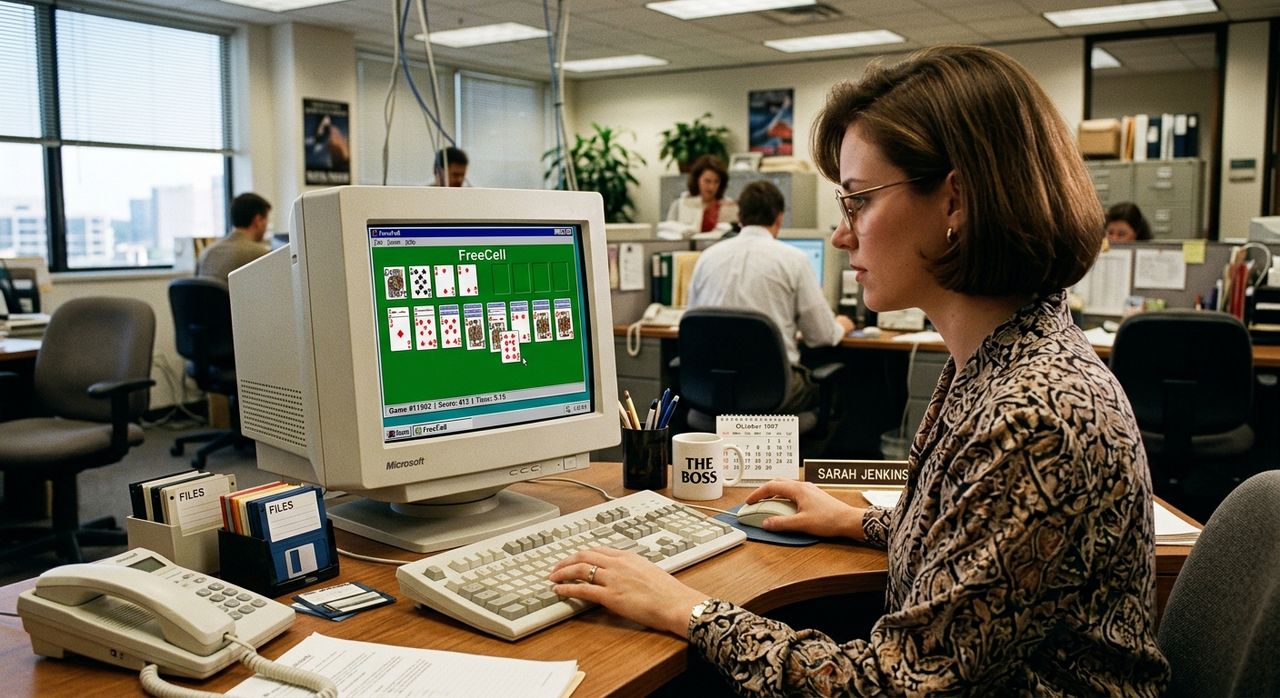
If you worked in an office at any point between 1995 and 2012, you probably saw FreeCell open on at least one colleague's monitor at any given moment. Maybe it was yours. The game had a peculiar grip on corporate America, sitting quietly in the Accessories folder of every Windows install, asking nothing of the user except a mouse and a few idle minutes. What made it stick was not flashy graphics or competitive leaderboards. It was something simpler: almost every deal was solvable, and that meant you could always try again.
Three Things Worth Knowing:
1. FreeCell was invented in 1978 on a PLATO mainframe, more than a decade before it appeared on Windows.
2. Jim Horne ported it to Windows NT and 95, giving it the visual form that millions of office workers memorized.
3. Microsoft removed it from Windows 8 in 2012, triggering complaints loud enough to show how deeply the game had embedded itself into daily routines.
The Mainframe That Started It All
Most people assume FreeCell was a Microsoft creation. It was not. The game traces back to 1978, when a developer named Paul Alfille wrote a version for the PLATO system), an early networked computer platform used primarily at universities and research institutions. Alfille's version introduced the core mechanic that defines FreeCell today: four free cells at the top of the screen that act as temporary parking spots for cards you need to move out of the way.
The deal structure was already there. Eight columns of cards, four empty foundation piles building up by suit, and the challenge of moving everything into order using only the free cells as a buffer. PLATO handled the building rule differently from what most Windows players know, but the skeleton was identical to what millions of office workers would stare at two decades later.
PLATO was not a household name. It ran on hardware the general public never touched. But it served as the incubator for a remarkable number of games and software ideas that eventually found much wider audiences once personal computers arrived in homes and offices. FreeCell is one of the cleaner examples of that migration from institutional computing to mass consumption.
Jim Horne and the Windows Deal
The jump from PLATO to Windows came through Jim Horne, a programmer at Microsoft. Horne encountered FreeCell, recognized what made it compelling, and built a version for Windows NT in 1991. It shipped with Windows 3.1 and then, more prominently, with Windows 95 and Windows NT 4.0. That 1995 release is the one that truly embedded the game in office culture.
Horne made a deliberate design choice that turned out to matter enormously. He numbered every deal from 1 to 32,000. This meant players could compare notes. If a colleague cleared deal number 617, you could load that exact same starting position and try to beat it yourself. The numbered deals created a shared vocabulary. People swapped deal numbers the way they later swapped puzzle seeds in other games.
Horne also built in a hidden wrinkle: deals numbered -1 and -2 are unsolvable by design. Every other deal in the standard set has a solution. That near-perfect solvability rate was not accidental. Losing to a bad shuffle feels arbitrary. Losing when a solution provably exists just means you have not found it yet. That distinction changed the emotional texture of the game entirely.
Why Offices Specifically
FreeCell had a structural advantage over Solitaire, the other bundled card game. Solitaire involved a meaningful luck component. Some deals were simply unwinnable, and there was nothing a player could do about it. FreeCell was almost entirely a game of skill and planning, which made failure feel like a puzzle to solve rather than a coin flip to retry.
That mattered in the office context. FreeCell could fill exactly the kind of gap that appears between tasks. Waiting for a file to save, a print job to finish, a meeting to start. The game was short enough to abandon mid-hand without guilt, but demanding enough to actually occupy the mind.
Here is what the typical FreeCell office experience looked like:
- Open a deal in a spare moment between tasks
- Spend two to five minutes planning the opening moves
- Get stuck somewhere in the middle columns
- Stare at it for another minute, find the right line, finish
- Close the window just before anyone walked past
The win percentage counter in the Windows version reinforced the habit further. It tracked every game played and every game won. For certain personality types, that number became a source of genuine investment. Players who had maintained a 90-plus percent win rate across hundreds of games were not going to let it drop over a careless mistake. The counter turned a casual pastime into something closer to a personal record that required protecting.
That loop repeated across millions of desks for nearly two decades, entirely without marketing, without tutorials, without any of the engagement mechanics that modern game designers spend careers building.
The Windows 8 Removal
Microsoft shipped Windows 8 in 2012 and, as part of a broader reorganization of bundled software, removed the classic card games including FreeCell. The games became available as a free download from the Windows Store, but they were gone from the default install.
The complaints were notably loud for something that most users would have described, if asked, as not a big deal. That reaction was itself revealing. The game had become infrastructure. People did not think about FreeCell the way they thought about software they had chosen and installed. It was simply there, the way a breakroom coffee machine is there, and its absence created a gap that felt disproportionate to its apparent importance.
According to the FreeCell entry on Wikipedia, the game has maintained consistent recognition as one of the most widely played solitaire variants in history, which goes some way toward explaining why its removal generated the reaction it did. Something that has been present on every computer you have used for nearly twenty years stops feeling like a feature and starts feeling like a given. Removing a given is a different thing from removing a feature.
The Older Variant That Put Suit-Building First
Before FreeCell existed in the form Horne coded, there was a related structure with a stricter rule. The baker's game uses the same free cells and the same foundations, but requires you to build tableau columns by suit rather than by alternating color. That single change makes the game significantly harder.
In standard FreeCell, you can place any red card on any black card of the next higher rank. In baker's game, you need the specific suit. A three of spades can only go on a four of spades. The range of available moves narrows considerably, and the planning required to work through a deal runs deeper.
Baker's game actually predates FreeCell as a concept. The suit-only building rule is the older constraint, and Alfille's PLATO implementation drew on that tradition before the color-alternation version became dominant. For anyone who spent years with the Windows version, trying baker's game is a useful way to feel how much cognitive work the looser rule was quietly doing for them. The free cells feel less free when the tableau building is more restrictive.
The two variants are close enough relatives that strong FreeCell players often assume they will transfer their skills immediately. Most find that baker's game requires a period of adjustment. The instincts are similar but the planning horizon needs to stretch further, because each move eliminates fewer options for recovery.
Daily Streaks and the Modern Win Counter
The closest modern equivalent to the win-percentage counter is the daily challenge format. If you want to play Freecell today, you get the same deal as everyone else who opens that day's challenge. A streak builds across consecutive days. Miss a day and the counter resets.
That format maps onto what motivated the most dedicated office players. It was never about a single win. It was about the accumulating record, the number that represented consistent performance over time. The daily deal compresses that into something more manageable, and the shared deal means you can still compare notes with other players the way colleagues once swapped numbered deals across cubicle walls. The social texture is different but the underlying motivation is the same.
What Two Decades in the Accessories Folder Actually Meant
FreeCell was never marketed. It never had a sequel. It never got a tutorial, an achievement system, or a social layer. It sat in the Accessories folder and waited. For roughly twenty years, that was enough.
The game's arc from a 1978 university mainframe to a default Windows install to a browser daily challenge is not the story of a blockbuster. It is the story of a design that was right in enough small ways to survive on its own merits through multiple eras of computing. The numbered deals, the near-perfect solvability, the win counter, the free cells that gave just enough slack to plan without making the game trivial.
Those were not accidents. And the complaints that followed the Windows 8 removal were not trivial either. They were evidence of a game that had done something genuinely difficult: become part of the daily rhythm of an enormous number of ordinary working people, without ever drawing attention to itself.
Leave a Comment