
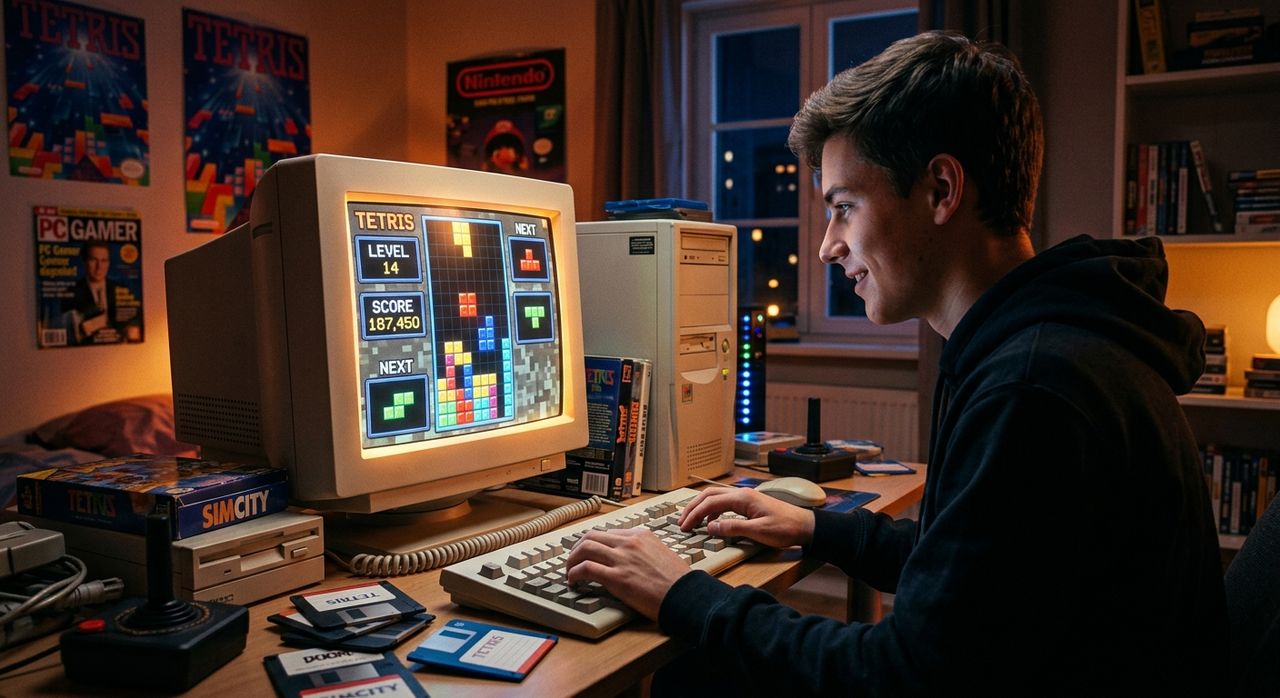
Before Steam libraries and instant downloads, puzzle games spread through floppy disks passed hand to hand in school corridors and office break rooms. One program showed up on more of those disks than almost anything else. It came from behind the Iron Curtain, got tangled in one of the messiest legal battles in gaming history, and arrived on American PCs in 1987 with no color, no sound card support on most machines, and no marketing budget to speak of. It still became the game everyone had to play.
Key Takeaway: Tetris started as a side project on a Soviet research computer in 1984 and reached western PCs through a licensing fight that nearly killed it entirely. The 1987 IBM PC port spread through shareware networks faster than almost any other title of its era. That simple falling-block formula, stripped of all modern assist features, still holds up as one of the purest tests of spatial reasoning a PC can run.
Born on a Machine Nobody in the West Had Heard Of
Alexey Pajitnov was a software engineer at the Dorodnitsyn Computing Centre of the Soviet Academy of Sciences in Moscow. In 1984, he was experimenting with a game concept on an Electronika 60, a Soviet terminal computer roughly equivalent to a PDP-11. The machine had no graphics capability in any meaningful sense. Pajitnov rendered his falling pieces using text characters on a monochrome screen.
The game borrowed its core idea from the board game Pentominoes: shapes made of connected squares fall from the top of a well, and the player rotates and drops them to fill complete horizontal lines. Pajitnov called the shapes tetrominoes, a play on the Greek prefix for four, and named the game Tetris.
It spread through Soviet research institutes almost immediately. People copied it to whatever storage media they had. Within months, versions were running on Electronika 60 machines across the USSR. Pajitnov had created something compulsive in its core loop, and he had done it with almost no hardware resources at all.
The Licensing War That Almost Stopped Everything
What happened next is one of the stranger episodes in gaming history. By 1986, a version had reached Hungary, where software publisher Andromeda made contact with Pajitnov and began arranging licensing deals. The problem was that all Soviet software was technically owned by the state. Pajitnov could not license anything. Andromeda licensed it anyway and started selling rights to western publishers before they actually had them.
Following the Tetris rights dispute, multiple companies ended up holding licenses they may not have legitimately owned. British publisher Mirrorsoft, American publisher Spectrum HoloByte, and eventually Nintendo all got caught up in competing claims. Atari and Tengen were dragged in too. Nintendo and The Tetris Company eventually prevailed, but not before several companies had already shipped products under licenses that turned out to be legally questionable.
For PC players, the chaos meant that the version that landed in America in 1987, published by Spectrum HoloByte, arrived in a cloud of uncertainty about who actually owned what. It did not matter much to the people playing it. The game was extraordinary.
Why the 1987 IBM PC Port Took Over Shareware Networks
The Spectrum HoloByte IBM PC release came with something unusual for the time: full-color graphics on machines that could handle them, and Russian-themed art on the loading screens that gave the whole package an exotic appeal during the Cold War. But on many IBM PC setups of 1987, players were still looking at CGA graphics or plain monochrome output. The game did not need color to work.
What spread on shareware networks was often the simplest possible version: falling blocks, a line counter, a score, and the endless pressure of the well filling up. Players passed it around because it worked on almost any machine and because explaining it to someone took about thirty seconds. You stack pieces. You clear lines. You go faster. You lose.
The features that made it so copyable were the same features that made it brilliant:
- No story to follow
- No progression system to track
- No saves required
- Fully functional in a few hundred kilobytes
- Instantly understandable, genuinely difficult to master
Those qualities meant you could drop it on a floppy alongside three other programs and it would run on whatever hardware your friend happened to own. By 1989, Tetris was installed on more PCs than almost any other title of its era.
What Classic Mode Actually Preserves
Modern Tetris releases have added a significant layer of assistance features over the years. Ghost pieces show you exactly where a falling block will land. Hold queues let you swap out a piece you cannot use right now. Extended previews show you the next five or six pieces in line. These features make the game more accessible and more consistent at high levels of competitive play.
Classic Tetris strips most of that away. No ghost piece. Limited or no hold. A short preview. The experience is much closer to what a player on a 1987 PC was actually dealing with: you read the piece, you read the board, and you commit. There is no safety net.
That difference is bigger than it sounds. Players who learned Tetris on modern versions often find the classic format disorienting at first. The ghost piece is not decorative. It is doing cognitive work for you. Without it, you are doing that work yourself, and at high speeds, that is exactly where the game gets hard in the way the original intended.
Then vs. Now: Key Features Across Eras
Feature | 1987 IBM PC Version | Modern Versions |
Ghost piece | None | Standard |
Hold queue | None | Yes |
Piece preview | 1 piece ahead | Up to 6 pieces ahead |
Rotation system | Original BPS | SRS (Super Rotation System) |
Speed cap | Level 29 kill screen | Variable, no hard cap |
Hard drop | No (soft drop only) | Yes |
Playing classic format is not nostalgia for its own sake. It is a genuinely different skill test, and for a lot of players who grew up in the late 1980s and early 1990s, it is the version their muscle memory was built around.
Sprint Mode and the Competitive Instinct That Never Left
Old-school PC players measured themselves by the line counter. The score was fine, but lines cleared told you something more direct about how efficiently you were playing. You could compare line counts with someone else who had played for the same amount of time and immediately know who had the tighter stacking game.
Sprint mode formalizes that instinct. The goal is to clear forty lines as fast as possible. No bonus points for style, no survival pressure from accelerating gravity. Just you, the well, and the clock. Your time is your number.
That format will feel immediately familiar to anyone who used to race friends in the same room on shareware Tetris. The line counter was always what mattered most. Sprint captures that competitive simplicity and gives it a proper structure. A player who can clear forty lines in under a minute has genuinely internalized the game's stacking logic at a level that takes real practice to reach.
The competitive Tetris scene that grew around formats like this is substantial now. Players have documented and formalized techniques that 1980s shareware players were using instinctively, without any names for them.
The Pieces Had Names, But Nobody Knew Them
Ask a player from 1987 what they called the long skinny piece. They will probably say "the long one" or "the stick." Ask about the S-shaped piece and you will get "the squiggly" or "the zigzag." The official letter-based naming system, where pieces are called I, O, T, S, Z, J, and L based on which letter they vaguely resemble, was not widely known among casual players for years.
The piece terminology reference fills in both sides of that gap. It covers the official names, the community names that developed organically over decades, and the mechanical concepts like "stacking," "T-spin," and "overhang" that players were practicing without standardized vocabulary. For anyone who learned the game from a shareware disk rather than a manual, seeing those informal terms defined and placed alongside the technical ones is a small but satisfying kind of recognition.
This is part of what makes retro Tetris interesting beyond pure nostalgia. The game developed a community language independently of official documentation, and that language is worth understanding if you want to talk clearly about what you are actually doing when you play at a serious level.
How Pajitnov's Side Project Became the Template for Everything That Followed
The list of ways Tetris changed puzzle game design is shorter than you might expect, because it did not just influence the genre. For a long time, it basically was the genre on PC.
- It proved that a puzzle game did not need a narrative hook to hold a player's attention for hours.
- It showed that increasing speed was a clean and scalable difficulty curve that required no new content to sustain.
- It demonstrated that spatial reasoning under pressure was a compelling skill loop on its own terms.
- It established that a game could spread through informal copying and become genuinely mainstream without traditional distribution.
- It set the template for score-based competition among friends in a local setting long before online leaderboards existed.
Every block-dropping, line-clearing, speed-escalating puzzle game that came after owed something direct to what Pajitnov built on that Electronika 60 in 1984. Games like Columns, Puyo Puyo, and Dr. Mario all took a premise that Tetris had made legible to a mass audience and built variations around it. None of them displaced the original.
What the Falling Blocks Left Behind
The IBM PC version of Tetris is now approaching forty years old. The machine it ran on is a museum piece. The shareware networks that spread it are long gone. But the game underneath all of that has not aged in any way that matters. The spatial puzzle it presents is the same puzzle it has always been, and the pressure of watching the well fill up does not get easier to handle just because you have played it a thousand times.
Most games from 1987 are interesting now as historical artifacts. Tetris is still interesting as a game. The classic format, the sprint challenge, the vocabulary built around the pieces, all of it points back to something that Pajitnov got exactly right on the first attempt: a loop so clean and so demanding that neither hardware limitations nor legal chaos nor four decades of imitation have managed to make it feel ordinary. That is the real legacy the Soviet Electronika 60 left on PC gaming.
Leave a Comment