
In 1962, a retired IBM researcher named Arthur Samuel sat across from Robert Nealey, a former Connecticut state checkers champion. Nealey was playing against a program running on an IBM 7094, a descendant of the IBM 701 machine Samuel had used since 1952 to build one of the most influential pieces of software in computing history. Nealey lost. Samuel's program won. And the term "machine learning," which Samuel himself coined to describe how the program improved through self-play, entered the public imagination in a way that still echoes in every AI conversation today.
Key Takeaways
- Arthur Samuel's checkers program, built on IBM hardware in the 1950s and 1960s, introduced the term "machine learning" and became a landmark in AI history.
- Checkers arrived on personal computers through DOS shareware bundles and the Microsoft Entertainment Pack throughout the 1980s and 1990s.
- Checkers is not a single game but a family of regional rulesets with meaningfully different rules, board sizes, and strategies.
- International draughts plays on a 10x10 board with mandatory multi-capture sequences that shift the game toward deep positional thinking.
- Canadian checkers uses a 12x12 board, the largest in the family, pushing piece counts and endgame complexity to an extreme.
The IBM 701 and the Birth of Machine Learning
Arthur Samuel did not set out to conquer checkers. He set out to prove a point: that computers could learn from experience rather than simply follow pre-written instructions. He chose checkers because it was complex enough to be interesting and simple enough to be tractable on the limited hardware of the early 1950s. The IBM 701 he worked with had roughly 2,048 words of memory. By modern standards it was laughably small. By 1952 standards it was the cutting edge.
Samuel's program stored board positions, evaluated them using a scoring function it refined over thousands of self-play games, and gradually built a library of positional knowledge. He described this process in a landmark 1959 paper as "machine learning," a phrase that would take decades to fully resonate but never really went away. You can read about Samuel's pioneering work in detail, and the connection between checkers and AI research remains one of the more underappreciated threads in computing history.
The Nealey match got press coverage at the time. IBM was keen to publicize its machines, and a computer beating a human checkers expert made for a good headline. What the headlines missed was the deeper significance: Samuel had built a system that improved through play, not through hand-coded rules. That distinction is the whole ballgame in modern machine learning.
From Mainframes to the Living Room: The DOS Era
After Samuel's mainframe experiments, checkers spent a couple of decades as a research curiosity rather than a consumer product. That changed in the early 1980s when personal computers started appearing in homes and small businesses. Checkers was an obvious fit for the new machines. The rules were widely known, the board state fit easily into memory, and the AI needed to produce a credible opponent was within reach of the processors available.
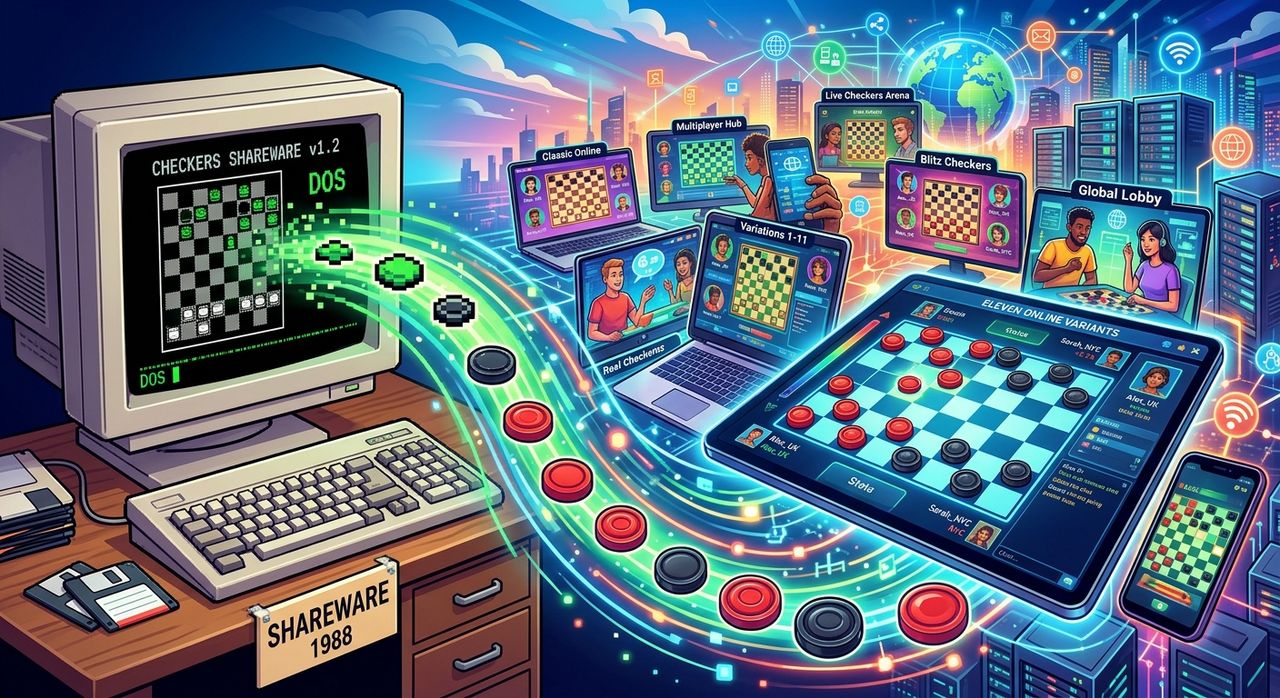
DOS shareware bundles were the primary distribution method. You might find a checkers program included on a floppy disk with a dozen other games, passed hand to hand or downloaded via a BBS. The quality varied enormously. Some programs played well. Many played badly enough that any experienced human player could beat them consistently. The appeal was novelty as much as challenge.
Microsoft changed the equation in 1990 when it included a checkers game in the first Microsoft Entertainment Pack for Windows 3.0. The Entertainment Pack was aimed squarely at office workers who spent their lunch breaks on company PCs, and checkers sat alongside Minesweeper and other games that became deeply embedded in the Windows experience. The packaging was polished, the interface was clean, and for many users this was their first encounter with checkers as a digital game rather than a board game.
Throughout the 1990s, checkers appeared in CD-ROM compilations, standalone retail releases, and bundled game suites. The AI improved gradually. Dedicated checkers programs reached a level where they could challenge strong human players. In 1994, Jonathan Schaeffer at the University of Alberta began the Chinook project, which eventually proved that checkers is a draw with perfect play from both sides, a result published in 2007.
Checkers Is Not One Game
Here is the thing that most people who grew up with DOS checkers never thought about: the version they played was American checkers, also called English draughts. And American checkers is one member of a much larger family. The checkers and draughts family spans at least a dozen recognized variants with meaningfully different rules, board sizes, and strategic demands. Treating "checkers" as a single game is a bit like treating "chess" as shorthand for every abstract strategy game played with pieces on a grid.
The regional variants emerged because checkers traveled. It arrived in different countries at different times, adapted to local preferences, and crystallized into distinct rulesets that locals treated as the definitive version of the game. A player who learned Russian checkers and a player who learned American checkers would recognize each other's game superficially but find the strategic assumptions almost completely different.
International Draughts: The 10x10 Standard
The most widely played variant outside North America and Britain is international draughts, played on a 10x10 board instead of the 8x8 board that American players know. The extra rows and columns change everything. There are 50 playable squares instead of 32. Opening piece development takes longer. Endgame positions are more complex. And the capture rules are substantially different from the American version.
In international draughts, captures are mandatory. If a capture is available, you must take it. If multiple captures are available, you must choose the sequence that captures the most pieces, a rule called the majority captures requirement. Kings, called "dams" in Dutch-influenced terminology, can move any number of squares diagonally in any direction rather than being limited to adjacent squares. This flying king rule dramatically increases the power of a promoted piece and changes the entire endgame dynamic.
The terminology around draughts can trip up players unfamiliar with the European tradition. A "dam" is a king in Dutch-influenced variants. A "man" is an uncrowned piece. "Huffing" was an older rule allowing you to remove an opponent's piece if they failed to make a mandatory capture, though this rule has largely disappeared from formal play. "Majority rule" refers to the requirement to take the maximum number of pieces in a capture sequence. A "tempo" in draughts refers to a move that maintains positional balance rather than gaining material, much as it does in chess.
These distinctions matter because international draughts is genuinely the most common form of the game in much of Europe and West Africa. If you grew up with the 8x8 version, the 10x10 board feels larger than it looks. The extra real estate forces a different kind of patience.
Russian, Brazilian, Pool, and the Rest of the Family
Russian checkers allows kings to continue moving after a capture in a way that American rules prohibit. Brazilian checkers uses the 8x8 board but applies international draughts rules, including the flying king and majority captures requirement. Pool checkers, popular in the American South, allows kings the same long-range movement as international draughts but on the 8x8 board. Italian checkers adds a restriction that ordinary men cannot capture kings, which changes piece promotion incentives significantly.
Spanish checkers reverses the diagonal direction used for captures compared to the American version. Czech checkers requires that when a king is available as a capturer, you must use it rather than a man, even if the man could take more pieces. Turkish checkers uses a completely different movement pattern, with pieces moving orthogonally rather than diagonally, making it feel almost like a different category of game entirely. Anti-checkers, sometimes called losing draughts or misere checkers, flips the win condition: the first player to lose all their pieces wins. The strategic inversion is disorienting at first but creates genuinely interesting positions.
Canadian Checkers: The Largest Board
At the far end of the size spectrum sits canadian checkers, played on a 12x12 board with 30 pieces per side. The starting setup alone has more pieces than the entire American game. The larger board extends opening preparation, gives positional play more room to breathe, and produces endgames of genuine complexity.
Canadian checkers follows international rules, including mandatory captures and flying kings, applied to the larger board. The effect is not simply "more of the same." With 72 playable squares instead of 50, the game develops more slowly, pieces have more escape routes, and the endgame calculation required for flying kings covers longer distances and more options. Players who transition from international draughts to Canadian checkers often describe the adjustment as more significant than they expected.
The 12x12 variant is the upper limit of what competitive checkers organizations have formally recognized, though informal variants on larger boards exist. It represents the furthest the core ruleset has stretched while remaining recognizably the same family of game.
Where to Play Today
The move from DOS shareware to the browser has been gradual and is now essentially complete. If you want to play Checkers online today, you can sit down against an AI opponent that adjusts to your skill level, switch between American and international rules, or try variants that would have required finding a specialized club or importing a physical set a generation ago.
The AI opponents in modern browser games are not Arthur Samuel's hand-crafted evaluation functions running on machines with kilobytes of memory. They use search algorithms and evaluation heuristics that would have seemed implausible on 1980s hardware. And they run instantly, in a browser tab, without installation.
From Punch Cards to Pixels: The Full Arc
Arthur Samuel proved in the 1950s that checkers was deep enough to teach a machine something meaningful about learning. DOS shareware proved in the 1980s that checkers was accessible enough to be every PC owner's first AI opponent. The Microsoft Entertainment Pack proved in the 1990s that checkers was familiar enough to sit next to Minesweeper without explanation.
What gets lost in that story is the variety. American checkers is one dialect. International draughts, with its 10x10 board and mandatory multi-jump sequences, is another. Canadian checkers, with its 12x12 expanse, is another still. The family tree is broader than most players ever had reason to consider when the only version available was the one bundled with Windows.
The gap between "checkers" as a generic label and checkers as a family of distinct regional games is the part of this history that the shareware era never quite communicated. It is, in hindsight, the most interesting part.
Leave a Comment