
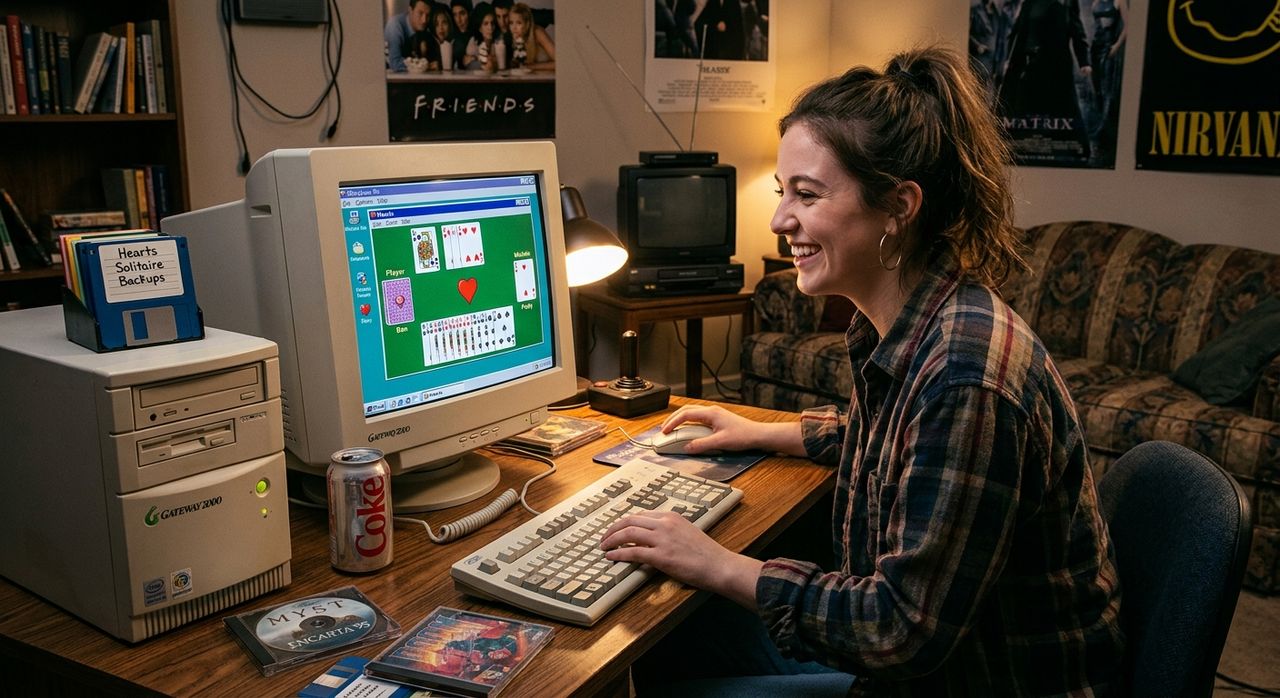
Nobody bought Hearts. That is the remarkable thing. There was no box on a shelf, no $49.99 price tag, no trip to the software store. Microsoft simply put it there, tucked inside Windows 3.1 in 1992, and suddenly hundreds of millions of computers around the world had a fully functional card game sitting in their Accessories folder. That quiet act of bundling turned Hearts into something extraordinary: statistically one of the most-played PC games in history, not through marketing or reviews or word of mouth, but because everyone already owned a copy.
Key Takeaway: Microsoft's decision to bundle Hearts with Windows 3.1 and every major release through XP made it a default fixture of 1990s computing. Few games reached as many players simply by existing on the machine. The queen-of-spades penalty rule traces back to the British card game Black Maria, a connection most players never knew. And decades later, many of these classic games are finding new life in the browser.
How a Card Game Ended Up in Every Office and Bedroom
When Windows 3.1 shipped, Microsoft was solving a specific problem. Computers were intimidating. Graphical interfaces were still new, and many users had never touched a mouse before. The bundled games, Solitaire included, served a practical function: they taught hand-eye coordination and made the machine feel approachable. Hearts, though, went further. It introduced players to networked multiplayer at a time when most people had no idea what networking even meant.
The original Windows version supported play over a local area network. That made it a fixture in offices everywhere. The corporate desktop, meant for spreadsheets and word processing, became a venue for lunchtime card games between colleagues on the same floor. IT departments occasionally tried to remove it. They rarely succeeded.
Hearts shipped with every major Windows release in sequence:
- Windows 3.1 (1992) introduced the game to the world
- Windows 95 updated the interface and preserved the network play
- Windows 98 and 98 SE carried it forward unchanged
- Windows Me included it as part of the full bundled games suite
- Windows XP refined the visuals and added three AI opponents named Pauline, Michele, and Ben
That last detail stuck with people. Those three names made the computer opponents feel almost like coworkers, or at least like personalities rather than subroutines. Players assigned traits to them. Michele was the risky one. Ben was consistent. Pauline was sneaky. None of that was programmed, but it felt true, and that feeling kept people coming back.
What Made Hearts Actually Fun
Strip away the nostalgia and Hearts is a genuinely clever game. Unlike most card games, the goal is to avoid taking certain cards rather than to accumulate them. Every heart is worth one penalty point. The queen of spades is worth thirteen. The player with the lowest score at the end wins.
That inversion, chasing something you do not want while trying to pass it to someone else, creates a specific kind of tension that very few games replicate. Every hand requires reading the room. You are not just thinking about your own cards. You are thinking about what your opponents are trying to avoid, and whether you can engineer a situation where they have no choice but to take the queen.
The Hearts card game) has roots going back to the late nineteenth century, but the Windows version introduced it to an entire generation of people who had never played cards seriously. For many, it was their first encounter with strategic card play. And because the rules appeared on screen whenever you asked, learning happened without friction or embarrassment.
The British Ancestor Behind the Queen-of-Spades Rule
The queen-of-spades penalty did not originate with Microsoft. It came from a much older tradition. Black Maria is the British card game that sits directly behind the scoring mechanic most Windows Hearts players accepted without question. In Black Maria, the queen of spades, called Black Maria herself, carries a heavy penalty, and the entire structure of the game is built around that one card's power to ruin a hand.
Most players in the 1990s never thought to ask where the rule came from. The computer just presented it as fact: avoid the queen of spades or pay thirteen points. But the logic behind that rule has a genuine history, and if you want to understand why that particular card carries such weight, you can play Black Maria in its original form and feel the difference immediately. The emphasis shifts. The queen becomes even more central. The rest of the hand is almost organized around managing her presence.
Black Maria is also the reason the game carries a certain British quality, even in its American computer form. The scoring system, the penalty structure, the social dynamic of passing dangerous cards to neighbors before the hand begins, all of that comes from a card-playing culture that valued controlled aggression and plausible deniability. You could not be blamed for the queen landing in someone else's hand if you had passed her there legally.
Windows Hearts and the Myth of the Accidental Gamer
One of the more interesting things about the Windows bundled games era is how it created players who did not think of themselves as players. The people who spent twenty minutes on Hearts before a meeting would have laughed at the label "gamer." They were just killing time. But they were learning card strategy, developing pattern recognition, and returning day after day because the game had genuine depth beneath a simple surface.
This is why Windows Hearts holds a different place in gaming history than most titles from the same period. Windows 3.1x reached an audience that commercial games could never touch. The people who bought Doom or Myst were enthusiasts who had already opted in. Hearts players were everyone else: secretaries and accountants and managers and retirees who happened to own a computer and found a card game waiting for them.
The numbers, when you try to estimate them, become staggering. Microsoft shipped over a hundred million copies of Windows during the XP era alone. Not every user played Hearts, but the percentage that opened it at least once was almost certainly enormous. No boxed game has ever had comparable reach by default.
The Games That Came With the Machine Are Back
Something is happening now that would have seemed strange to predict. The games that came bundled with nineties computers are finding new audiences online. Not through emulation exactly, though that exists too, but through browser-based reimplementations that let anyone pick up where they left off without installing a thing.
Solitaire went first. Then Minesweeper. Hearts has followed. And outside the Windows ecosystem entirely, other games from the same Commonwealth card-and-board tradition are returning the same way. Uckers, the naval mess-deck board game that has been a fixture of British military culture for generations, is a good example. You can now play uckers online without needing a physical board or six people in the same room. The games that people once played in closed communities, whether in offices or aboard ships, are slowly becoming accessible to anyone curious enough to look.
This speaks to something genuine about how people relate to games they grew up around. There is no replacing the experience of clicking through a Hearts hand at a desk in 1997 with the sound of a dot-matrix printer in the background, but the browser versions get closer than you might expect. The rules are the same. The tension around the queen of spades is the same. The satisfaction of watching an opponent absorb thirteen points on a single card is exactly as it was.
When the Accessories Menu Was the Whole Point
Windows Hearts was not incidental to the computing experience of the 1990s. For a significant portion of computer owners, it was the computing experience. The machine was there to run word processors and maybe print things, and Hearts was there to make the machine feel worth having in a different way.
Microsoft did not know it was shaping a generation of casual players when it dropped a card game into the Accessories folder. It was trying to sell an operating system and make the mouse feel natural. But the accidental reach of that decision outlasted Windows 3.1, outlasted XP, and outlasted nearly every commercial game that competed for attention in the same decade. The queen of spades haunted more computers than any villain in any blockbuster title from that era. She still does, in her own quiet way, waiting patiently for anyone who wants a hand.
Leave a Comment