
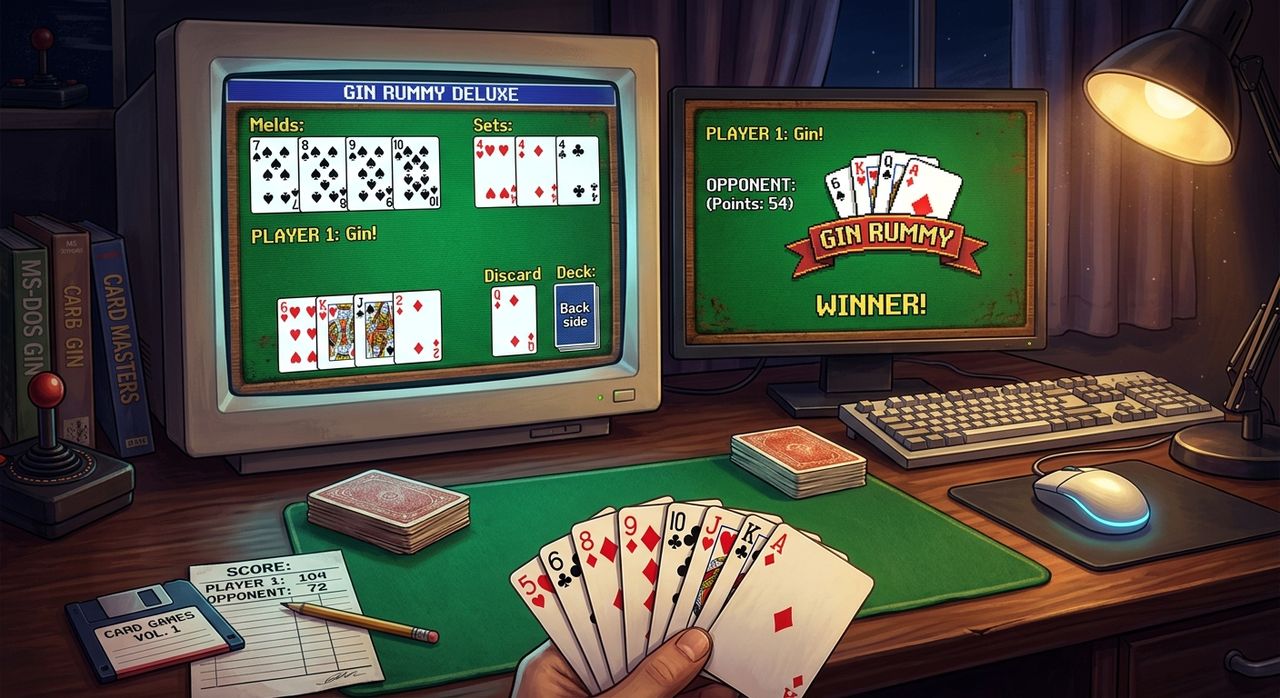
If you browsed the software racks at any computer store between 1982 and 1995, you noticed something consistent. Card game collections almost always led with Gin Rummy. Not Poker. Not Blackjack. Not even Bridge, which had a longer pedigree as a prestige game. Gin Rummy sat at the top of the box art, got the most screen time in the demo mode, and earned its own entry in the help menu. That was not an accident. There were very specific technical and design reasons why Gin Rummy became the default card game on early personal computers, and understanding them says a lot about how constraint shapes creativity.
Key Takeaways:
- Gin Rummy's fixed 10-card hand gave early programmers a bounded, manageable state space for AI logic
- Knocking and going Gin provided clear, binary end conditions that simplified game loop design
- Low randomness variance meant skill decisions mattered more, making even shallow AI feel competent
- In-game help text had to cover terms like "deadwood" and "undercut" because floppy-disk releases rarely included full printed manuals
- The same vocabulary still trips up new players today, making a solid glossary reference worth keeping bookmarked
The Floppy Disk Problem Nobody Talks About
Early PC software shipped on floppy disks. That sounds obvious, but the storage constraints were genuinely severe. A double-density 5.25-inch floppy held roughly 360 kilobytes. Even the double-sided, double-density disks that became standard by the mid-1980s topped out around 720KB. Later HD disks brought 1.2MB. That was it. Your entire game, help system, graphics, and AI had to fit in that space.
This forced brutal efficiency on developers. Every system in the game had to justify its code size. If your card AI required megabytes of lookup tables or a complex search structure, it was not going on that disk. The AI had to be small, fast, and still capable of making decisions that felt meaningful to the player.
Gin Rummy solved this problem almost perfectly.
Why Gin Rummy Fit the Hardware
Fixed Hand, Bounded World
Gin Rummy is played with 10 cards per player. That is the whole hand. It does not grow beyond 10 before you draw, and after you draw you discard back down to 10. Compare that with Bridge, where you hold 13 cards and must reason about partner signals, trump suits, bidding conventions, and a full auction phase. Or Canasta, where hands grow large and meld stacks compound in complexity.
With 10 cards, the state space an AI had to evaluate was contained. A programmer in 1984 working in 8-bit assembly could write a Gin Rummy opponent that fit under 20KB and still made sensible plays. That was a real competitive advantage when customers wanted something that worked on their 64K machine.
Knocking and Going Gin
The end conditions in Gin Rummy are clean and binary. You either knock when your unmatched cards total 10 points or less, or you go Gin when every card is part of a meld and you have zero deadwood. That is the whole objective. There is no multi-stage scoring phase, no trump hierarchy to track, no auction to model.
Binary end conditions matter for game AI because the evaluation function becomes simple. The AI asks one question: how close am I to knocking or going Gin? That question has a measurable numeric answer. Deadwood count is your score. Lower is better. A developer could write a working AI around that single heuristic and it would play reasonable Gin Rummy. The game's own structure did most of the work.
What Low Variance Actually Means for Players
Variance in card games refers to how much luck influences individual outcomes. High-variance games like Poker produce wildly different results hand to hand because the betting structure amplifies small card-value differences into huge swings. Gin Rummy is lower variance by design.
Both players draw from the same deck. The discard pile is public knowledge. You see every card your opponent picks up from the discard. You watch what they throw away. Over a session of ten or twenty hands, the better player wins more often than in a high-luck game. That predictability was not just good for players. It was good for AI design.
Here is why it mattered to developers specifically:
- A Gin Rummy AI could track the discard pile and deduce probable opponent melds
- Public information meant fewer hidden variables to simulate
- The AI could make "smart-looking" decisions using only observable data
- Players who lost felt they made a mistake, not that the computer got lucky
That last point is critical. Early PC game reviews often criticized weak AI. A Gin Rummy AI that used discard-pile tracking felt clever, even when the underlying code was a simple probability table. The game's structure did the heavy lifting.
The Vocabulary Problem and In-Game Help Text
There was another challenge early developers faced that rarely gets discussed. Gin Rummy has a specific vocabulary, and that vocabulary is not self-explanatory from the interface alone.
Terms like deadwood (the unmatched cards in your hand, counted by point value), undercut (when you knock and your opponent has equal or lower deadwood, earning them a bonus), gin bonus (the extra points awarded for going Gin with zero deadwood), and knock card (the face-up card that sets the maximum deadwood allowed to knock) are all essential to playing correctly. A player who does not understand what an undercut is will make costly mistakes and not understand why they lost points.
Printed manuals were thin, sometimes nonexistent, especially for budget card game compilations. This pushed developers to write in-game help screens that covered the full glossary. The help menu entry for Gin Rummy in many 1980s card game packs ran longer than the entries for Poker, Blackjack, and Solitaire combined. The game needed explanation because the rules rewarded precision. Players who want a reliable reference for this vocabulary today will find the same terms unchanged, since the game has not drifted from its original ruleset.
How the Major Card Games Compared to Gin Rummy on Early Hardware
The clearest way to understand Gin Rummy's advantage is to see what it was competing against for space on those floppy disks:
- Bridge: 13-card hands, two-player teams, private signals, full auction phase. AI complexity far exceeded what a 64K machine handled gracefully.
- Canasta: Large meld stacks, multiple card types with special rules, team play. Too much state to track cheaply.
- Poker: Required opponent modeling and betting simulation. Included in many packs, but the AI was notoriously bad because genuinely good Poker AI is hard.
- Cribbage: Close to Gin in simplicity but the peg-counting phase and crib mechanic added a second evaluation layer that cost code space.
- Blackjack: Trivially simple to program but offered almost no AI depth. Players beat it by memorizing basic strategy. It got included but never featured.
Gin Rummy sat in a sweet spot: complex enough to feel like a real game, simple enough to implement well with minimal resources.
Why Early Reviews Praised the Gin Rummy AI
Read through old magazine reviews from publications like Compute! or PC Magazine from the mid-1980s and you notice a pattern. Reviewers who complained about weak AI in card game packages made an exception for Gin Rummy more often than for other games.
Because the AI could use discard-pile tracking, it made observable, logical decisions. Players could watch the AI refuse a card from the discard pile and understand the AI was protecting information. That visible reasoning felt intelligent, even when the underlying code was a simple probability table.
The numbered steps a typical Gin Rummy AI followed looked something like this:
- Score all possible draws from the discard pile against current deadwood count
- Identify which cards in hand contribute to no meld and discard the highest point value
- Track opponent discard patterns to avoid feeding their melds
- Evaluate knock opportunity against an estimate of opponent's deadwood
- Prefer Gin over knocking when within one draw of zero deadwood
That five-step logic, written in assembly language, fit in a few hundred bytes and produced an opponent that genuinely challenged most casual players. It is still roughly how computer Gin Rummy AI works at the introductory level today.
What the Software Houses Got Right That We Tend to Forget
It is tempting to look at early PC card games as primitive. They had no animation. Their graphics were blocky ASCII art or simple bitmapped cards. The sound was a beep on draw and a beep on knock. But the designers made good choices under real pressure.
They chose Gin Rummy because it was honest. The game rewarded skill more than luck. The AI could be competitive without pretending to be something it was not. The vocabulary was worth teaching because the rules were worth learning. And the fixed structure of the game, 10 cards, one goal, two outcomes, created a session length that fit naturally into a lunch break or an evening wind-down.
That intentionality is what made the game a catalog staple rather than a filler title. Every software house learned that customers who played Gin Rummy came back to play again. The retention was real, and it translated directly into repeat software sales at a time when word-of-mouth reviews mattered more than any advertisement.
Gin Rummy's Lasting Place in Computer Gaming History
The early PC card game catalogs were not democratic. They reflected hard engineering constraints and market feedback processed over years of trial and error. Gin Rummy earned its position at the top of those catalogs by being the game that worked best inside the limits developers were given.
Its fixed hand, binary end conditions, low variance, and self-explaining public information combined to make an AI opponent that played well, taught itself through the discard pile, and made players feel like skill was the deciding factor. In an era where memory was measured in kilobytes and storage in single floppy disks, those properties were not conveniences. They were survival traits.
The players who learned the game on those early machines stayed loyal to it. When card gaming moved online and then to mobile, the audience was already there, already trained, already attached to the specific rhythm of drawing and discarding and watching the pile. Today, new players who want to understand what generations of fans discovered on beige CRT monitors can play Gin Rummy with the same rules that made it a floppy-disk staple in the first place.
The next time you see a card game labeled "classic" in a software catalogue, check whether Gin Rummy is in the collection. It almost certainly is. And now you know exactly why.
Leave a Comment