
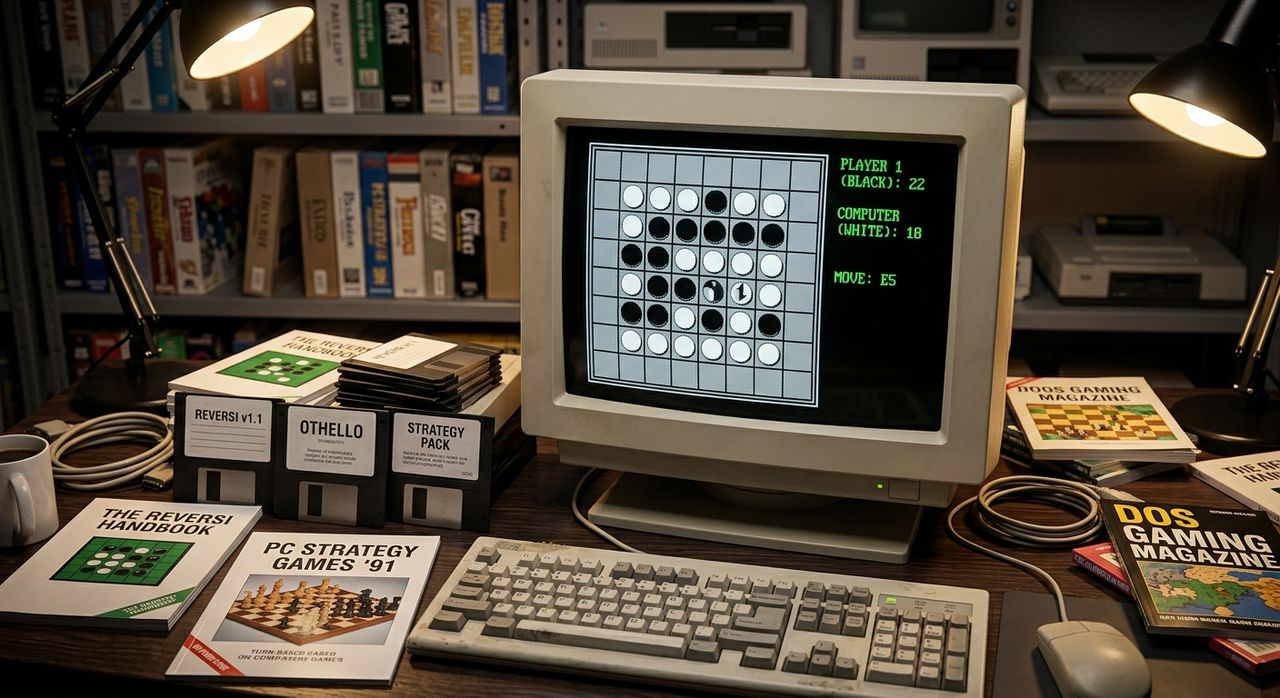
If you spent serious time with a DOS machine in the 1980s, you almost certainly played Reversi, or Othello, or something called "Flipper" or "Disk Game" that was clearly Reversi in different clothes. The number of distinct implementations that shipped for DOS was extraordinary even by the standards of a platform that attracted obsessive programmers. No other pure strategy game came close on a per-title basis. Chess had famous ports. Checkers appeared occasionally. But Reversi showed up everywhere, written by everyone, at every level of programming ambition. What made this particular game so irresistible to so many programmers at exactly the same moment? The answer sits at the intersection of algorithms, ambition, and a very forgiving set of rules.
Key Takeaways:
- DOS received more distinct Reversi and Othello implementations than almost any other strategy game, ranging from hobbyist freeware to Mattel-licensed retail releases
- The 8x8 grid and flip mechanic made Reversi the first practical AI showcase that everyday home computer users actually played and took seriously
- Mattel Electronics held the Othello trademark in North America, creating a naming split that still trips up vintage gamers today
- Scaling the board beyond 8x8 reproduces the same exponential strategy complexity the DOS programmers were chasing in their evaluation functions
- Classic two-player PC games including Hearts variants have migrated successfully to browsers, keeping the social experience intact without any installation required
Why the 8x8 Grid Was Perfect for Learning AI
The reason Reversi attracted so many programmers was almost embarrassingly practical. The rules fit on a single notecard. The board state could be stored in a handful of bytes. Legal move generation was fast even on an 8088 processor running at 4.77 MHz. And a halfway-decent minimax algorithm with basic alpha-beta pruning could produce a computer opponent that felt genuinely threatening to a casual player, without requiring weeks of implementation work.
For a generation of programmers teaching themselves artificial intelligence from photocopied textbooks and library books with cracked spines, this was remarkable. You could write a Reversi engine in a weekend, show it to friends, and have it actually beat them. Most had already tried chess and hit a wall. Chess has too many piece types, too many positional subtleties, and the search tree explodes in complexity far faster than a beginner expects. Reversi was the game where you could feel your AI getting smarter as you improved the evaluation function. That feedback loop was addictive, and it kept programmers coming back for another version, another refinement, another challenger.
The Shareware Machine That Fed the Explosion
By the mid-1980s, a recognizable pattern had formed. A programmer would write a Reversi clone, distribute it through a bulletin board system or a local user group disk library, and within months a slightly improved version from a different author would appear in the same channels. The game's simplicity made comparison immediate and honest. Two programs could play each other. You could measure progress directly in wins and losses, which was deeply satisfying in a way that more subjective improvement metrics could not match.
The freeware and shareware ecosystem of the DOS era fed this cycle perfectly. Authors did not need a publisher or a retail arrangement to reach players. A working program on a floppy disk, uploaded to a BBS in the right city, could spread to thousands of machines in a few months through the informal copying culture of the period. Reversi titles moved through this system faster than almost anything else in the strategy category because file sizes were tiny and programs ran on anything. CGA graphics were good enough. EGA made things prettier but did not change the experience. Even fully text-mode versions appeared regularly, because the board did not need color to be readable or playable.
From Hobbyist Floppies to Mattel's Licensed Othello
The commercial side of this story runs parallel to the shareware explosion. Mattel Electronics acquired the Othello trademark in North America during the 1970s, which meant that any program sold in a box with "Othello" on the label required a license. The underlying game predates Mattel's trademark by nearly a century, which explains why so many DOS programs called themselves Reversi, Disk Flip, or something else entirely while being functionally identical to the licensed product.
Mattel eventually released an officially licensed Othello for Windows in the early 1990s. It was a competent product, properly boxed, priced at retail, and sitting on software store shelves next to much more expensive titles. Meanwhile, freely available Reversi programs with comparable or stronger engines circulated on floppies for nothing. The retail version sold on reputation and branding, because the underlying game was not proprietary. Any programmer could write the same thing and call it Reversi without anyone threatening legal action.
The Name Problem That Still Trips People Up
This is where things get genuinely confusing for anyone who came back to the game after a long absence. The distinction between reversi vs othello is not just trivia. It explains why a game you bought in a box at a toy store and a game a friend gave you on a floppy disk felt identical but carried different names, and why online discussions about "the best DOS Othello" and "the best DOS Reversi" tend to describe the same programs without realizing it.
The short version: Reversi is the original public-domain game with roots in the 1880s. Othello is a trademarked variant with standardized starting positions and official tournament rules. For casual play, the rules are nearly identical, which is precisely why the confusion persists across generations of players. DOS programmers writing freeware used the public-domain name to stay clear of legal complications. Programmers writing retail products used the licensed name because it carried brand recognition. Players ended up with both terms floating around, with no obvious way to know which was which, and the internet did not exactly fix that problem.
What the Board Was Actually Doing to Your Brain
The genius of Reversi as an AI test bed was not just its simplicity. It was the way the board's strategic value shifted over the course of a game. A corner square that is irrelevant for the first twenty moves becomes critical in the endgame. Edge control means something different at move fifteen than at move forty. A strong DOS-era engine had to know when to prioritize mobility, when to hunt for corners, and when to sacrifice material to force the opponent into bad positions.
This is the part that made the game genuinely difficult to master programmatically, even though the rules were easy. The evaluation function was the whole problem. Every DOS programmer who wrote a Reversi engine had their own theory about which factors mattered most, and the only way to test a theory was to let it compete against something else. That competitive pressure produced a surprising diversity of approaches even among programs with similar overall strength.
The idea of scaling the board is where this history connects directly to what modern implementations are doing. When you play grand reversi on a larger grid, the same strategic principles that feel manageable on 8x8 begin to interact in ways that feel genuinely new. The corner problem becomes a problem about multiple corners simultaneously. Edge control requires managing longer stretches of board at once. The DOS programmers were already hitting the outer limits of what 8x8 could teach them, and a bigger grid would have been exactly what many of them wanted if the hardware of the time had made it practical to search.
The AI Showcase That Happened Before Chess Got Famous
There is a larger cultural claim worth making here, one that tends to get buried under discussions of specific programs and release dates. Reversi, not chess, was the first strategy game AI that ordinary home computer users actually played and took seriously as a thinking opponent. Chess programs existed, but strong ones required hardware that most home users did not have in the early 1980s. The chess software that ran on affordable machines was often weak enough that a casual player could demolish it, which undercut any sense of playing against genuine intelligence.
Reversi engines running on a stock IBM PC clone were different. A well-written program with decent alpha-beta pruning and a competent evaluation function could beat most casual players consistently. This was not a novelty act. It was a demonstration that the computer was making real decisions, reading the board, and outplaying a human being. For many people, the Reversi program on their office PC in 1986 was their first real encounter with what machine intelligence looked like in practice. That moment came years before chess engines became household names, years before the public conversation about artificial intelligence focused on games at all.
The origins of the game itself stretch back to Victorian England, which makes the timing even more striking. A game invented in the 1880s became the testing ground for personal computer AI in the 1980s, almost by accident, because its computational properties happened to match what affordable hardware could actually handle within a reasonable response time.
Classic Two-Player PC Games That Made the Browser Transition
The migration of classic PC games to the browser has been uneven. Many titles lost something essential in translation, whether because the interface relied on keyboard shortcuts that do not map well to mouse-and-click, or because the rules were too complex to communicate without a physical manual, or because the original experience depended on a kind of committed setup that a browser tab simply cannot reproduce.
Two-player games with clean rules have fared better than most. Hearts is a good example. The card game that shipped with Windows 3.1 introduced a generation to computer card gaming, and the core experience, four players, point-avoidance, the shooting-the-moon gambit, transfers to the browser without losing much. The experience of getting a game going when you play Omnibus Hearts takes about as long as loading a floppy disk used to, and the social structure of the game stays completely intact. The slow accumulation of risk across a hand, the sudden reversal when someone moons the table, the satisfaction of watching someone else collect the Queen of Spades by accident. That kind of friction-free migration is what the DOS shareware model was always trying to achieve, just through different technology.
The Grid That Launched a Thousand Programs
Reversi had more DOS ports than almost any other strategy game because it was the right game at the right moment for the right set of problems. It was simple enough to implement in a weekend, rich enough to improve on for years, and compelling enough that ordinary players wanted to play it against the computer and lose with some dignity. Every programmer who wrote a version learned something real about search algorithms and evaluation functions. Every player who lost to a well-written engine got their first genuine sense of what a thinking machine felt like.
That is not a small legacy for a public-domain game invented in Victorian England and then refined into a trademarked product by a Japanese toy company almost a century later. The DOS era gave it more sustained attention than it had ever received, in more forms, from more directions, than any similarly abstract game managed to attract in that period. The questions those programmers were trying to answer, about board value, efficient search, and building an opponent worth beating, remain the same questions that make larger-grid versions feel fresh even now. The 8x8 board was never the limit. It was just where everyone happened to start.
Leave a Comment