
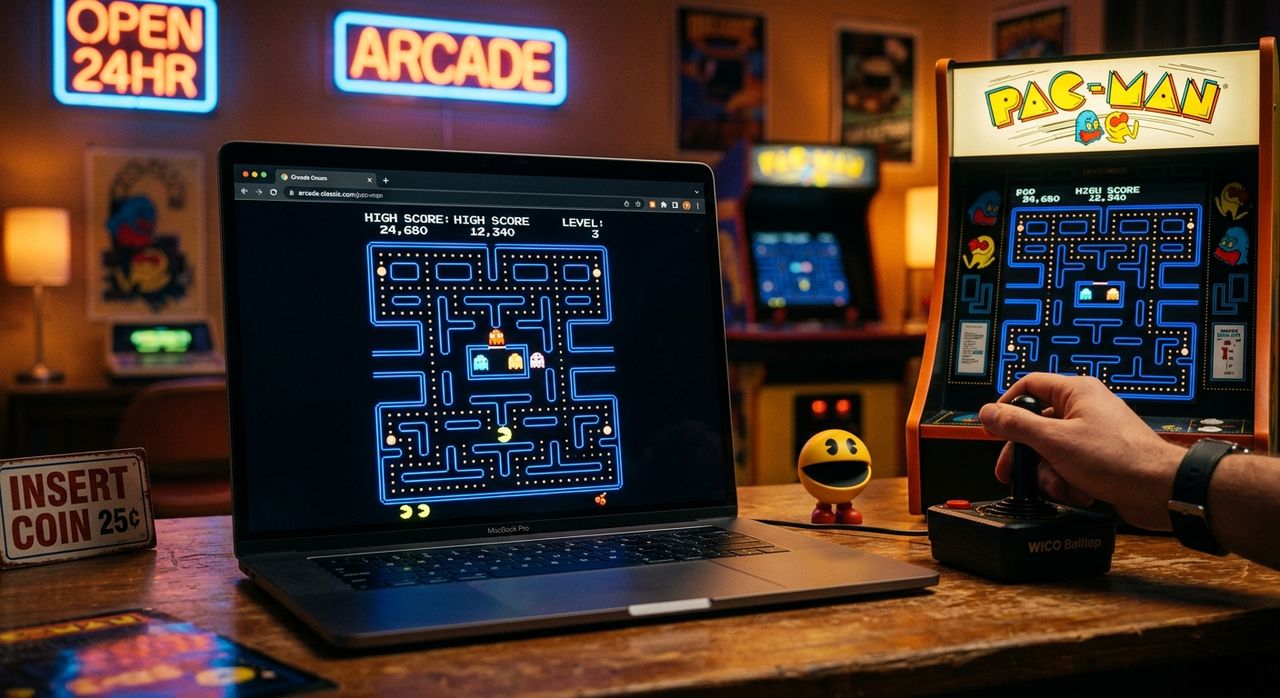
Something changed the moment Pac-Man lit up an arcade cabinet in 1980. Toru Iwatani's maze game felt different from everything else on the floor, simpler in concept but deeper in practice. You ate dots, you fled ghosts, and you studied the patterns. Forty-five years later, the maze is still eating your attention, and you no longer need a pocket full of quarters or a downloaded DOS executable to find out why.
Key Takeaways:
- Pac-Man debuted as a Namco arcade cabinet in May 1980 and became one of the best-selling arcade games ever made
- Early PC ports on DOS and Windows captured the spirit but often lost graphical or audio fidelity compared to the original cabinet
- Browser-based versions now replicate the arcade experience with no installation, no emulator, and no configuration required
- Ghost rush mode raises the ghost count to six, mirroring the kind of escalating AI pressure retro gamers once memorized route by route
- A daily challenge gives modern players the same ritual of returning to the same board that arcade regulars once had with a favourite cabinet
From Namco Cabinet to Household Name
Pac-Man arrived in Japanese arcades in May 1980 under the name Puck Man. Namco changed the title for Western markets before Midway distributed it stateside. What followed was unprecedented. The game drew players who had never touched a joystick, including women and children who found Space Invaders too aggressive, and couples who played side by side at the same machine. By 1982 there were licensed adaptations spanning cereal boxes, a Saturday morning cartoon, and a Billboard-charting pop song. The cabinet itself was selling out faster than Namco could manufacture them.
The appeal was never just the visuals. It was the ghost behavior. Blinky, Pinky, Inky, and Clyde each followed distinct targeting logic, and experienced players could map those patterns into repeatable safe routes. You were not just reacting to what appeared on screen. You were solving a system that ran on fixed, learnable rules.
The Long Road to the PC Screen
Home computing in the early 1980s was not kind to arcade ports. The Atari 2600 version of Pac-Man is still cited as one of the more notorious mismatches between source material and adaptation. The crisp maze became muddy. The ghosts flickered. The sound effects landed somewhere between a belch and a beep.
DOS players got a better deal as hardware improved through the mid-1980s. Later Microsoft DOS versions pushed noticeably closer to the original cabinet. By the time Windows 3.x and Windows 95 arrived, a wave of Pac-Man variants appeared, including compilations from Namco that grouped the classic alongside Ms. Pac-Man and Pac-Land. These boxed releases were a staple of budget software shelves and bargain bins across the decade.
The core experience held up, but you were always aware of the gap. Color palettes shifted between ports. Maze proportions changed. The ghost AI, while functional, never felt quite as finely tuned as the code running on the original Namco hardware.
What Made the Original Ghost AI Worth Studying
If you spent serious time with Pac-Man in arcades or on early PC ports, you probably already know the four ghost personalities by name. Understanding them was the difference between scraping 10,000 points and clearing boards with a consistent rhythm.
Here is how each ghost's targeting logic worked in the original Namco cabinet:
- Blinky (red) targeted Pac-Man's current tile directly, growing faster as the dot count dropped below a threshold Pac-Man fans call "Cruise Elroy" mode.
- Pinky (pink) aimed four tiles ahead of the direction Pac-Man was facing, which led to a famous overflow bug causing her to target the upper-left corner whenever Pac-Man faced upward.
- Inky (cyan) used the most complex formula, combining Blinky's position with a point two tiles ahead of Pac-Man to determine a vector, then doubling that vector to find his target tile.
- Clyde (orange) chased Pac-Man directly when far away but retreated to his home corner once he came within eight tiles, making him unpredictable for players who had not yet spotted the pattern.
Understanding these four rules turned the game from a frantic scramble into something closer to a spatial puzzle. Retro gamers spent hours internalizing the behavior because consistent routes produced consistent scores, and consistent scores meant your initials stayed on the high score table.
Six Ghosts and What That Actually Means for Your Routes
Modern browser versions of Pac-Man have no single standard. Some are faithful clones, some add variations that push the formula into new territory. The most interesting addition for anyone who grew up studying ghost behavior is a mode that raises the ghost count from four to six.
Two extra ghosts do not sound dramatic until you are inside a maze corridor and realize your usual escape route is covered from both ends. The patterns you memorized on four-ghost layouts no longer apply cleanly. You have to rebuild your mental model on the fly, mid-run, with two additional targeting systems bearing down on you. Anyone who has played through the original cabinet's later boards, where Blinky's Cruise Elroy threshold kicks in early and the remaining safe fruit windows shrink, will recognize that feeling. The pressure is familiar, just amplified in a way that demands new thinking.
If that sounds like your kind of session, play ghost rush and see how quickly your muscle memory either saves you or betrays you. The layout stays faithful to the original maze structure, which means your old pattern knowledge still gets you partway there. The sixth ghost is the variable that keeps it honest.
No Emulator, No Configuration, Just the Maze
One thing DOS players from the 1990s will appreciate immediately is how little friction the browser version asks of you. There was a period when playing a classic arcade game on modern hardware meant hunting for a DOSBox configuration, adjusting CPU cycles manually, mapping keyboard inputs to whatever peripheral you had available, and hoping the sound card emulation cooperated. That era had its own charm, mostly the satisfaction of making something old run again on hardware it was never designed for, but the setup process was never the game itself.
A browser tab removes all of that overhead. The maze appears. You move. The ghosts come out of their box following the same targeting logic they always did. The dot-eating loop, the energizer pellets, the brief window where the ghosts turn blue and the power dynamic flips, all of it is intact. It runs on whatever machine you are sitting in front of, whether that is an aging Windows laptop, a Mac, or a tablet propped up in a kitchen.
A Daily Ritual That Mirrors the Arcade Floor
There is something specific about how arcades worked as social spaces in the early 1980s. The same players came back every day. They signed their initials to the high score table. They showed up knowing the machine would be there, the same maze, the same ghosts, the same unresolved personal challenge from the session before.
That rhythm is harder to replicate at home. A game you own outright can be played to completion and shelved. The compulsion to return fades once the mystery is resolved. What kept arcade regulars coming back was not novelty, it was ritual. The machine was always there. It always had something to prove.
A daily challenge mode does something structurally similar. The board resets on a fixed schedule. Everyone who plays on a given day runs the same configuration. Your score has context because it sits alongside scores from other players who faced exactly the same board on exactly the same day. The machine is always there, and it always has something new to show you.
For that experience, play Pacman daily and see whether the habit of returning each day feels familiar. For anyone who spent serious time in an arcade or in front of an early PC port, it probably will.
The Maze That Never Really Closed
Pac-Man has outlasted the cabinet format, the home computer era, the CD-ROM compilation cycle, and the era of downloaded ports. It survived each transition because the core loop is genuinely durable. Eat, evade, strategize. The ghosts are still following the same logical rules Toru Iwatani encoded in 1980. The maze is still the same shape it was on day one.
What has changed is the distance between you and the game. That distance is now essentially zero. No coin. No emulator. No configuration file. No monthly subscription to a retro gaming service. The same experience that launched a cultural phenomenon forty-five years ago is sitting in a browser tab, waiting for you to remember which corners are safe.
Old PC gaming readers know better than most that the best games age well not because they look impressive but because they play well. Pac-Man has always played well. It still does.
Leave a Comment