
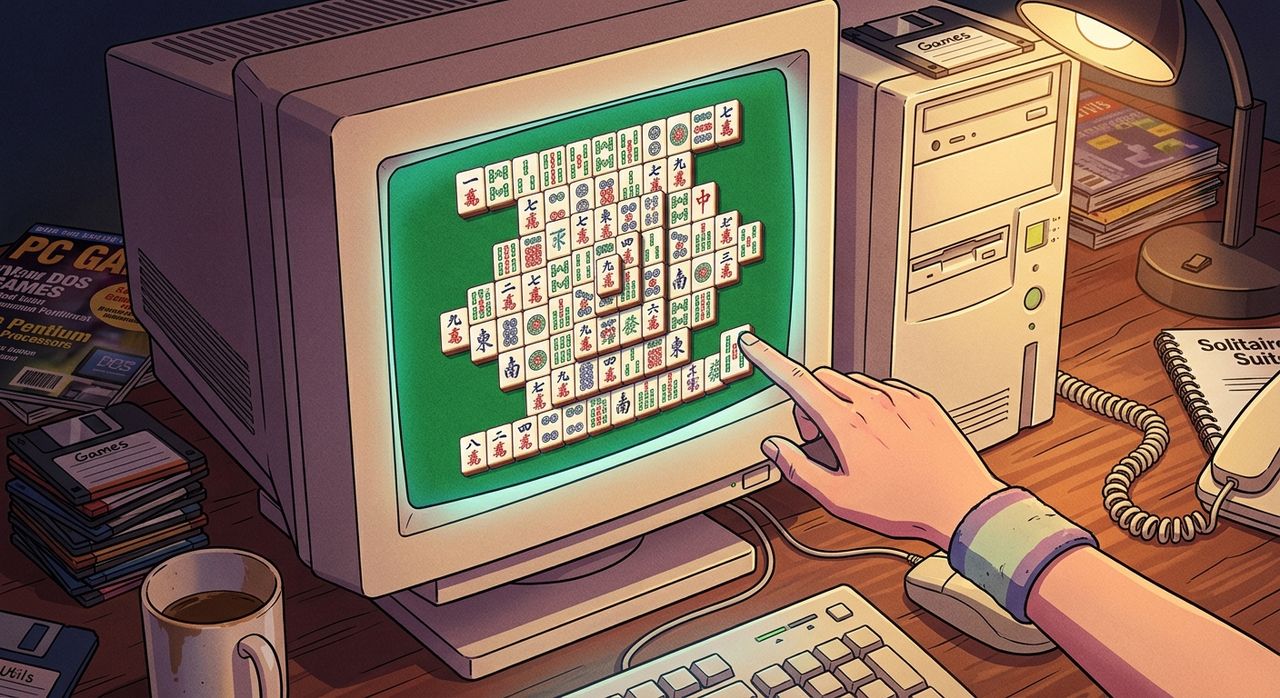
There is a game that shipped on millions of office computers throughout the late 1980s and 1990s, one that workers played in stolen ten-minute blocks between spreadsheets and memos, and it almost never gets mentioned alongside Doom or Civilization or even Minesweeper. That game is Mahjong Solitaire. Not the four-player Chinese tile game. The solo, click-the-matching-tiles version. The one that asked almost nothing of the player and gave back something genuinely satisfying in return.
Key Takeaway:
- Activision's Shanghai (1981) brought tile-matching solitaire to personal computers with no rule memorization required
- The mechanic rewarded spatial awareness over strategic planning, making it perfect for short play sessions
- Board shape, not tile content, was the real design lever, and layouts like pyramid mahjong show how geometry alone changes the difficulty curve
- Named layouts such as spider mahjong created a shared visual vocabulary that 1990s DOS compilations established
- Today's browser versions have preserved this design language faithfully, connecting modern players to that original office-PC experience
The Game That Needed No Manual
Activision released Shanghai in 1981, and the concept was almost insultingly simple. You had a stack of tiles arranged in a specific pattern. Each tile had a symbol. You clicked two matching tiles that were both free, meaning uncovered and not blocked on either side. They disappeared. You kept going until the board was clear or you ran out of moves.
That was it. Those core matching rules) boiled down to a single paragraph, and most players absorbed them just by watching the game for ninety seconds. This was not an accident. Activision designed it that way, and it turned out to be a masterclass in accessible game design long before anyone used the word "accessibility" in that context.
The traditional Chinese game of Mahjong is a genuinely complex four-player experience with regional variants, scoring systems, and tile combinations that take real time to learn. The solitaire version borrowed only the tiles themselves, the visual language of bamboo sticks and circles and Chinese characters, and threw out everything else. The result was something brand new wearing familiar clothing.
Why Office Workers Adopted It So Fast
The early 1990s office was a strange place for entertainment. You had a computer on your desk, usually running DOS or early Windows, and it was absolutely not supposed to be used for games. But lunch breaks happened. Slow afternoons happened. The install process for most games required floppy disks and fifteen minutes of setup, which made sneaky gaming impractical.
Mahjong Solitaire solved that problem neatly. Microsoft bundled Mahjong Tiles in a Windows game collection starting in 1990, which meant it arrived pre-installed alongside Minesweeper and Solitaire on a huge number of corporate machines. No installation required. No CD to hide in a drawer. You opened it from the program manager, played for eight minutes, and closed it before your manager walked past.
The spatial thinking angle mattered too. This was not a game that asked you to react fast or memorize sequences. It rewarded a calm, methodical scan of the board. You looked for pairs, assessed which tiles were actually free, considered which removals might open up more options further down. It felt productive in a way that pure reflex games did not. You could almost convince yourself you were exercising your brain rather than goofing off, and in a sense you were.
The Board Shape Was the Real Design Lever
Here is something that does not get enough credit in retrospective coverage of early PC games: in Mahjong Solitaire, the layout of the tiles matters far more than the tiles themselves. The tiles are almost irrelevant as long as they form matched pairs. The board shape is everything.
The classic turtle arrangement, which appeared in most early versions of the game, stacks tiles in the center and fans them out, creating a dense core that forces players to work from the edges inward. Change that shape and you change the entire feeling of the game. A taller, narrower stack plays differently from a flat one. Removing the central column entirely opens new paths that alter every removal decision. The board geometry controls the solvability curve in ways that rule changes never could.
This is why layouts became such an important part of the genre. Consider pyramid mahjong as a modern illustration of the principle. The triangular construction means tiles at the base are accessible first, and clearing upward requires a kind of reverse-engineering of the structure. A solver who attacks a pyramid layout the same way they approach a turtle layout will hit a dead end almost immediately. The shape teaches the strategy, not any written instruction. You internalize it by playing, and that understanding transfers to how you think about the board as a whole.
Named Layouts as a Design Convention
By the time DOS compilations started appearing in the mid-1990s, publishers had figured out that variety kept players returning. A single layout got boring eventually. Give someone eight or twelve or twenty layouts and suddenly the game has the feel of a progression, even if the underlying mechanic never changes.
This is where the visual vocabulary of named layouts really took hold. Each layout in a compilation carried a name that was a direct description of the shape you were looking at. Spider, fortress, dragon, pyramid. The naming convention was functional rather than decorative. It told the player what kind of spatial challenge to expect before they made a single move.
Spider mahjong is a good illustration of how this worked in practice. The layout earns its name visually. The tile arrangement has a clear spreading quality that you recognize before you read the label. This connection between name and shape meant that players who encountered the spider layout in a 1994 DOS compilation and then found it again in a 1998 Windows game felt immediate recognition. The vocabulary had transferred across versions, publishers, and years.
Browser-based versions today have preserved this naming tradition almost without change. The layouts are not dramatically different from what appeared in mid-1990s compilations. Some have been refined for screen proportions or touch interaction, but the core shapes and their names have survived intact. That is a longer shelf life than most game design conventions manage.
What Made It Different from Other Casual Games
It is worth sitting with a comparison between Mahjong Solitaire and its contemporaries because the differences explain a lot about why it lasted.
Solitaire, the card game, required knowledge of card values and a sense of probability. Minesweeper at harder difficulty levels required genuine deductive reasoning and the willingness to accept occasionally unsolvable boards. Mahjong Solitaire sat in a different position entirely. It rewarded visual pattern recognition above everything else, and it did this in a way that felt immediately accessible to someone who had never played a computer game before.
The qualities that made it work came down to specifics:
- No hidden information. Unlike Minesweeper, every tile was visible at all times. You could see exactly what you were working with and plan accordingly.
- No time pressure in the base version. Unlike arcade-style casual games, you could sit and think without penalty.
- Clear feedback loops. Every match removed tiles and made the board slightly less complex. Progress was always visible.
- Short session support. You could stop mid-game and come back without losing context, which suited office play perfectly.
- Scalable difficulty through layout choice rather than rule change. The same game felt harder or easier depending on which board you chose, not which settings you toggled.
These qualities made it genuinely suitable for the office environment in a way that other games were not. Casual gaming as a category did not really exist yet as a marketing concept, but Mahjong Solitaire was practicing its principles years before the terminology caught up.
The Lunch-Break Game That History Forgot
Gaming history tends to remember peaks. The revolutionary titles, the technical achievements, the games that changed what people thought computers could do. Mahjong Solitaire does not appear in those conversations very often, and that is a genuine omission.
It ran on hardware that cost a fraction of what dedicated gaming PCs required. It reached an audience that never would have sought out a game store or a gaming publication. It spent years inside the offices of people who thought of themselves as absolutely not gamers, and it gave those people a daily ritual that was genuinely enjoyable. That is a real achievement, and it happened at scale.
The design philosophy it embodied, zero barrier to entry, fully visible information, spatial rather than memorized knowledge, still holds up as a framework for thinking about casual game design. The best mobile puzzle games of the smartphone era were built on very similar principles, and many of their designers almost certainly played Mahjong Tiles on a Windows 3.1 machine at some point in their past.
The Tiles That Time Carried Forward
The game never disappeared. It adapted. DOS compilations gave way to Windows versions, which gave way to browser versions, which gave way to mobile apps. At each stage the layout vocabulary came along with it. The spider, the pyramid, the fortress, the dragon. The same names, recognizably the same shapes, serving the same purpose they always did.
There is something worth pausing on in that continuity. A design decision made in a mid-1990s DOS compilation, to give layouts memorable names that matched their visual shapes, turned out to be durable enough to survive three decades of platform shifts. The players who grew up with those names still recognize them. New players pick up the associations without needing to be told where they came from.
That is what good design does. It outlasts the hardware it was born on. And maybe that is why Mahjong Solitaire deserves a place in the conversation about early PC gaming that it has never quite claimed for itself. Not as a footnote. As a genuine example of how simplicity, done right, carries further than complexity ever does.
Leave a Comment