
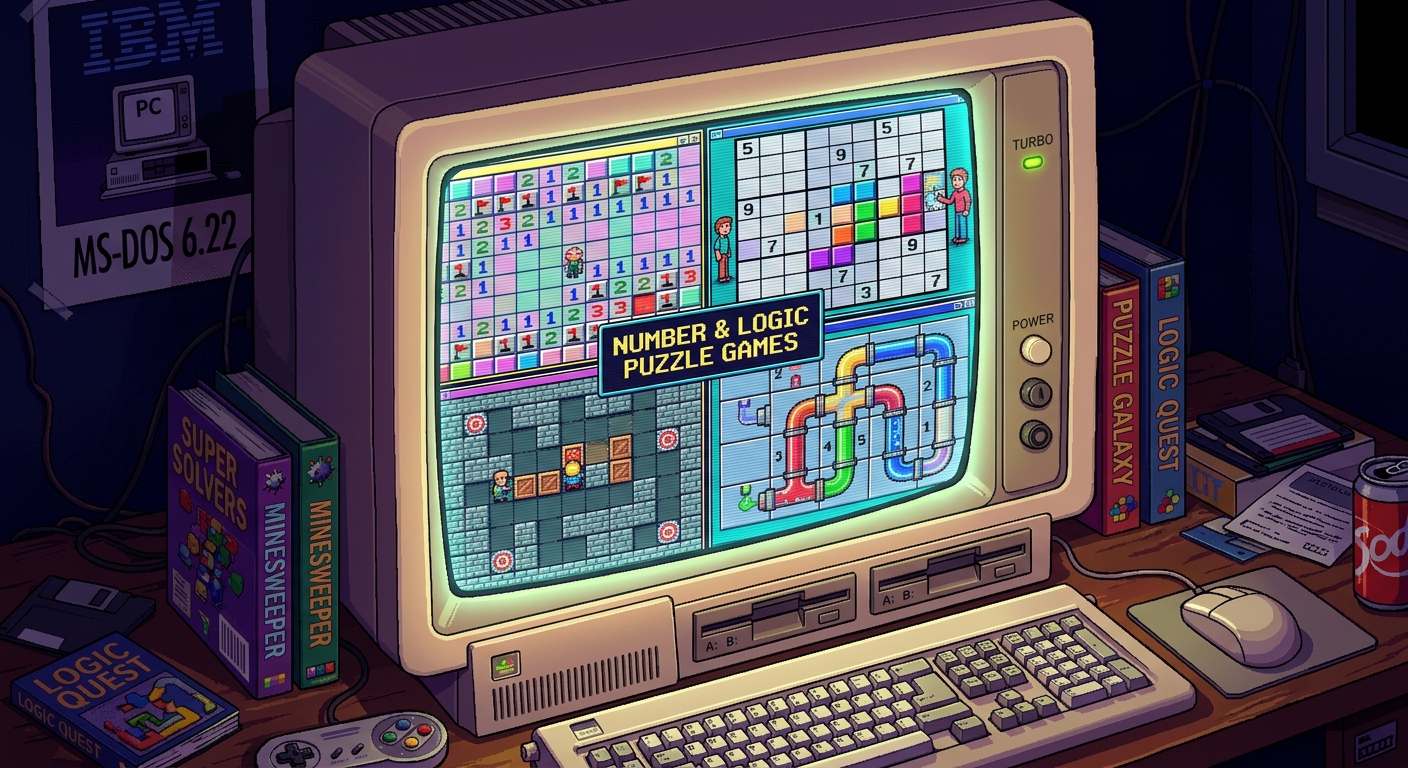
Somewhere between the flashy action games and sprawling RPGs that defined the DOS era, a quieter genre was doing something remarkable. Number and logic puzzle games were making people stare at their monitors for hours, fingers hovering over a keyboard, locked in a battle of pure reasoning. These games rarely got the magazine covers. They did not spawn movie tie-ins. But for a certain kind of player, they delivered something the louder genres never could: the clean, satisfying snap of a solution falling into place.
What This Retrospective Covers
DOS and early Windows logic puzzle games formed a tight, inventive genre built on one honest promise: if you think hard enough, you will solve it. From grid-based deduction titles that circulated on BBS boards to polished commercial releases that shipped in cardboard boxes, these games rewarded patience and systematic thinking in ways that still hold up. Several run in DOSBox today with minimal configuration, and the mental satisfaction they offer has not aged a single day.
The Genre That DOS Made Its Own
The PC was not the natural home of the arcade reflex game. A keyboard was a clunky input device compared to a joystick, and the processing power of a 286 or 386 machine could not compete with console hardware for smooth scrolling and sprite animation. For puzzle games, though, none of that mattered. A grid drawn in ASCII or basic EGA graphics was perfectly adequate. The logic was the hardware.
That practical reality shaped an entire ecosystem of puzzle software throughout the late 1980s and 1990s. Shareware distribution made it easy for small developers to reach players directly. A programmer working from a spare bedroom could release a number puzzle game, charge a modest registration fee for the full version, and find an audience without needing a retail deal. Many of the genre's best examples came out of exactly that pipeline. The low overhead meant developers could take risks with format and structure that larger studios often avoided.
Minesweeper and the Games That Built on Its Foundation
Most players encountered logic-based grid puzzles through Minesweeper, which shipped as part of the Windows Entertainment Pack before Microsoft bundled it with Windows 3.1 in 1992. Its genius was deceptive simplicity. The rules fit on a napkin, but the reasoning required to play well without guessing was genuinely demanding. Corner deductions, island counting, probability mapping across uncertain zones. Players who took it seriously were quietly learning formal logic without knowing it.
What the history of that game often skips is how many independent developers took its core format and pushed it in unexpected directions. Grid-based deduction games appeared throughout the shareware circuit with added layers: multiple mine types with different reveal behaviors, hexagonal grids that broke the spatial assumptions players had built up, and time-scored variants that forced speed alongside accuracy. The Minesweeper format proved to be one of the most extensible puzzle frameworks the era produced. The full documented history of grid-based mine-clearing puzzles traces its roots back to mainframe software from the 1960s, long before it ever reached a desktop machine.
Chip's Challenge and the Art of Layered Rules
Chip's Challenge arrived on PC through the Windows Entertainment Pack in 1992, ported from the Atari Lynx original. It combined tile-based movement with a growing set of environmental rules: ice patches, fire, water, keys, buttons, teleporters, directional blocks. Each new element introduced in the early levels would return later, combined with others in configurations that required careful planning before the first move.
The game's difficulty felt fair in a way that not every puzzle game managed. It never cheated you with hidden information or arbitrary timing. If you failed a level, you had every fact you needed to succeed. The puzzle was purely a reasoning problem. That clarity made repeated attempts feel rewarding rather than punishing. You were not fighting the game's systems. You were working through a problem the game had set up honestly.
Chip's Challenge also demonstrated how thin narrative framing could make a logic game feel purposeful without adding complexity. The premise of a kid solving puzzles to join a computer club gave each level set a goal worth caring about. That emotional hook is easy to underestimate in a genre that could otherwise feel like abstract exercise.
Shareware Brain-Teasers That Rarely Get Their Due
Beyond the titles that made it into retail packaging, the shareware circuit was rich with number and logic games that circulated on floppy disk through computer clubs, BBS boards, and magazine coverdisks. Sherlock, which presented grid-based logical deduction puzzles using clue relationships between categories, found loyal audiences even without major marketing. NumberMaze and similar number-path games were passed around school computer labs and office networks throughout the early 1990s.
What united the best of these games was a commitment to solvability. The designers who built shareware puzzle titles knew their players were paying attention. These were not casual time-killers. A puzzle with an unfair trap or an ambiguous solution would generate complaint letters and damage reputation in tight-knit BBS communities. That accountability produced tighter, better-designed puzzles than the commercial market sometimes managed.
The Incredible Machine, while better known for its Rube Goldberg contraption-building, also demanded careful logical sequencing and cause-and-effect reasoning that placed it firmly in the puzzle tradition. Sierra's polished production values brought the genre to players who might not have sought out more austere shareware titles, and the game's influence on puzzle design through the 1990s was lasting.
What Fair Difficulty Actually Looked Like
One of the defining features of the best DOS-era puzzle games was the distinction between difficulty that came from complexity and difficulty that came from obscurity. Fair difficulty means the player has all the information they need. The challenge is in the reasoning, not in guessing what the designer intended or in finding a hidden trick the game never telegraphed.
This principle maps directly onto the experience of sitting down with an extreme Sudoku challenge. A well-constructed extreme grid is not hard because the rules are complicated. It is hard because the correct move at each step requires longer chains of inference. You must hold more conditions in mind simultaneously and commit to deductions that feel uncertain until they resolve. That is the same cognitive demand that Chip's Challenge and the better Minesweeper variants were placing on players thirty years ago.
The best DOS puzzle designers understood that difficulty should scale through depth, not through opacity. A beginner-level grid and an expert-level grid share the same rules. The expert grid simply requires more steps to resolve, with fewer intermediate certainties to catch you along the way. That design philosophy produced games that felt genuinely challenging without ever feeling cheap.
Five Standout Titles Worth Tracking Down
Not every worthwhile logic game from the DOS era had a large marketing budget. The following five titles represent the range of the genre and each holds up well under modern play.
- Chip's Challenge (1992): The definitive example of layered environmental logic. All 149 levels of the original are still fully accessible, and a later Steam release restored content that was cut from the Entertainment Pack version for licensing reasons.
- Pipe Dream (1989): Pipe-laying under time pressure, requiring forward planning and spatial reasoning in a format that still feels immediate and tense. The DOS version ran on hardware as modest as a 286 and remains one of the most elegant time-pressure puzzle designs of the era.
- The Incredible Machine (1992): Logic through physics simulation. Every puzzle had a fixed solution, but the path to it involved understanding a chain of cause and effect that required careful experimentation and planning before committing to a layout.
- Sherlock (1991): A pure logical deduction game based on relationship grids, similar in structure to Einstein's Puzzle. It generated unique puzzles each session, giving it strong replay value for players who enjoyed its stripped-back format.
- Atomix (1990): A molecule-building puzzle game that required spatial reasoning and planning several moves ahead on a confined grid. Its unusual visual language was a barrier at first, but players who pushed past it found a demanding and rewarding puzzle system underneath, one that punished guesswork and rewarded methodical thinking.
DOS Logic Puzzle Games at a Glance: Compatibility and Access
| Game | Year | Core Difficulty Style | DOSBox Compatible | Where to Find It Today |
|---|---|---|---|---|
| Chip's Challenge | 1992 | Layered environmental rules | Yes | Steam (updated version available) |
| Pipe Dream | 1989 | Spatial planning under time pressure | Yes | Abandonware archives |
| The Incredible Machine | 1992 | Cause-and-effect sequencing | Yes | GOG.com (preconfigured) |
| Sherlock | 1991 | Pure logical deduction | Yes | Abandonware archives |
| Atomix | 1990 | Spatial reasoning and pre-planning | Yes | Abandonware archives |
Running These Games on Modern Hardware Without the Headaches
The practical situation for DOS puzzle games is better now than at any point since the 1990s. DOSBox is mature, well-documented, and handles the vast majority of DOS-era puzzle titles without issue. Most of these games made minimal hardware demands even in their own time, which means compatibility problems are rare. A modern DOSBox configuration for a 386-era puzzle game is straightforward and runs without the audio or timing issues that sometimes affect action game emulation.
The Internet Archive hosts playable browser versions of many titles through its historical software preservation efforts, which removes the setup step entirely for casual revisiting. For players who want to run native DOS binaries with a full configuration, the process is short and reliable.
First, install the current stable release of DOSBox from its official distribution. Second, create a dedicated folder on your drive for DOS games and mount it as the C drive in your dosbox.conf file. Third, copy the game files into a subfolder within that directory. Fourth, adjust the cycles setting in the configuration to around 3000 for early-1990s titles. This prevents speed issues that can affect timer-based puzzle games on modern hardware. Fifth, launch DOSBox, navigate to the game folder using basic DOS commands, and run the executable. Most DOS puzzle games from this era need nothing beyond that baseline setup.
For titles available on GOG.com, the process is even simpler. GOG bundles a preconfigured DOSBox installation with each purchase. The Incredible Machine series runs out of the box from a GOG download with no additional configuration needed, which makes it an ideal starting point for anyone new to DOS emulation.
The Case These Games Make for Thinking Slowly
There is something about a well-constructed logic puzzle that contemporary game design has not fully replaced. Modern puzzle games are often excellent, but many lean on spectacular presentation, incremental unlocks, and social mechanics to sustain engagement. The DOS-era puzzle games had none of that to fall back on. The puzzle was the entire product. That forced a concentration on the core reasoning challenge that is rare in the current market.
Playing Chip's Challenge or working through a Sherlock grid today is a different experience from playing a modern mobile puzzle. There is no ambient music calibrated to trigger a response. There is no streak counter nudging you to log in tomorrow. It is just the problem and your ability to reason through it. For players who grew up with these games, that austerity is not a limitation. It is the point.
The DOS era built a logic puzzle genre on one honest premise: that players were smart, patient, and genuinely interested in the challenge. That premise produced some of the most elegantly designed puzzle software ever written. Finding those games, installing DOSBox, and working through them today is not nostalgia tourism. It is just good puzzle gaming.
Leave a Comment