
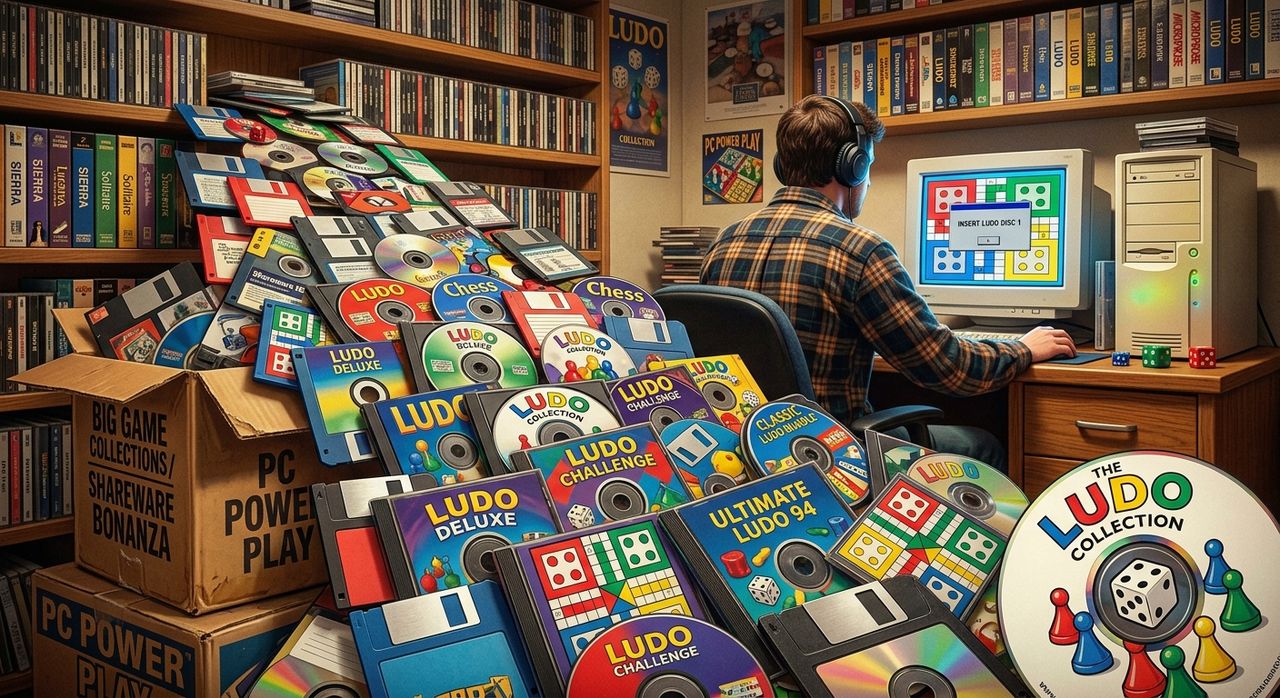
Pop open a CD-ROM from 1993 and scroll through the game list. Somewhere between the solitaire clone and the mahjong tile-matcher, you will almost certainly find Ludo. Not sometimes. Almost always. For a board game that traces its roots to a British patent filed in 1896, its dominance in the early days of home computing is remarkable, and completely logical once you understand what made it attractive to publishers operating on shoestring budgets and tight deadlines.
Ludo's leap from Victorian parlor to DOS prompt was no accident.
- The rules can be explained in under two minutes, which meant zero tutorial budget required.
- A functional AI opponent requires minimal processing power, fitting neatly inside the tight memory constraints of early home computers.
- Even a poorly coded AI can produce genuinely tense finishes, giving players a sense of competition without demanding sophisticated programming.
The Victorian Shortcut That Lasted a Century
The story starts with a British man named Alfred Collier, who simplified Pachisi) into a version he patented in 1896 under the name Ludo. The core change Collier made was elegant. He replaced the cowrie shell dice of the ancient Indian original with a standard six-sided die and stripped away much of the complexity around forfeiture rules and multiple pawn interactions. The result was a game that almost any child could grasp after watching a single round being played.
That simplicity was a commercial decision as much as a design one. Victorian toy makers were selling into homes where families gathered around a single table for entertainment. A game that required a lengthy rulebook was a game that gathered dust. Ludo hit shelves with a pitch that basically amounted to: roll the die, move your piece, try to get home first. The rules fit on the inside of the box lid.
Nearly a hundred years later, software publishers were facing the exact same problem from a different angle.
Budget Compilations and the Economics of Filler
By the late 1980s, the home computer market had a specific business niche: the compilation disc. Publishers would bundle ten, fifteen, or even twenty games onto a single floppy or CD-ROM and sell the package at a price point well below what individual titles cost separately.
The economics were straightforward. A compilation needed crowd-pleasers to justify the shelf price, but those titles cost licensing fees. The remaining slots were filled with games that were cheap and fast to produce. Board games and card games were ideal candidates. Here is why:
- No original art assets needed beyond a simple board graphic
- Sound requirements were minimal, often just a dice-roll effect and a brief fanfare
- Save state complexity was low since most games ended in under thirty minutes
- Testing was relatively simple compared to action or adventure titles
Ludo checked every box. A competent programmer could have a working implementation running in a week. The board is symmetrical, the movement logic is straightforward, and the only genuinely tricky part is coding the decision logic for when to send an opponent's piece home versus when to play it safe.
The AI Problem That Was Not Really a Problem
Here is where Ludo gets genuinely interesting from a design history perspective. Most board game AI in the DOS era was, by any modern standard, terrible. Chess AI required enormous computing resources. Draughts AI was passable. Backgammon AI needed statistical modeling that pushed the limits of consumer hardware.
Ludo AI needed almost none of that sophistication. The core decisions in Ludo come down to a small set of recurring choices:
- Do you move a piece out of home when you roll a six, or advance an existing piece instead?
- Do you chase down and send home an opponent piece when you land on it, or take a safer route?
- Do you push a piece into the protected home column early, or keep it out as a threat?
- When multiple pieces can move, which one takes priority?
A programmer could hard-code simple heuristics for each of those decisions and produce an opponent that felt competitive to a casual player. The randomness of the dice did the rest. Because no Ludo session unfolds identically, even a basic rule set creates variance, and variance creates tension. The AI does not need to play brilliantly. It just needs to react to board states in ways that do not feel obviously stupid.
This is exactly why modern digital versions of the game can still generate the same pressure the old DOS compilations did. The underlying tension between taking risks for faster progress and playing it safe is baked into the rules themselves. Readers who want to understand that tension at a strategic level will find the Ludo tips FAQ breaks down precisely the kind of decisions that make the game feel competitive, the same decisions the 1990s AI was clumsily trying to simulate.
The CD-ROM Boom and the Family Game Bundle
The early 1990s brought CD-ROM drives into mainstream homes, and with them a new wave of compilation titles marketed heavily at families. The pitch was pure value. A single disc could contain dozens of activities, and Ludo sat naturally alongside card games, tile puzzles, and word games in that format.
Publishers like Avanquest, GSP, and dozens of smaller European outfits built their entire product lines around these compilations. Some of their titles, particularly in the UK and Germany, shifted significant volume. Ludo was almost always present, often sitting alongside Snakes and Ladders, because the two shared an aesthetic: bright colors, cheerful board designs, and rules your grandmother already knew.
The familiarity was the selling point. A parent browsing a software aisle in 1994 did not know what half the games on a compilation disc were. But they recognized Ludo. That recognition translated directly into purchase confidence, which translated into sales.
Why Weak AI Actually Helped
There is a counterintuitive argument to be made that the mediocre AI common in early Ludo implementations was, perversely, part of the appeal rather than a failing.
Strong AI in a racing game like Ludo would consistently make the optimal move. Over time, that creates a specific kind of frustration: the feeling that no matter what you do, the opponent is always one step ahead. Weak AI, by contrast, makes mistakes. It leaves pieces vulnerable. It fails to block you when it should. And then the dice go against you anyway and it wins.
That cycle of human error combined with AI unpredictability and dice randomness produces something that feels like genuine competition even when it technically is not. Players walked away from early Ludo sessions with the same feeling they got at a kitchen table: a mixture of triumph, frustration, and the strong urge to play one more round.
The Publishers Who Put Ludo in Millions of Homes
A handful of specific titles deserve credit for embedding Ludo into the computing landscape of the era. The UK publisher GSP produced a string of family-oriented compilations sold through supermarket software racks at prices that undercut nearly everything else on the shelf. Avanquest released similar products under multiple retail brand names across Europe, particularly in France and Germany where board game compilations found unusually strong audiences. Smaller budget labels in Scandinavia and the Netherlands followed the same template.
None of these products are remembered as landmarks of game design. That is exactly the point. They were everyday software, the kind that sat in family homes alongside word processors and drawing programs. The brand names changed from country to country. The Ludo board looked identical in all of them.
From Collier's Patent to the Modern Screen
Ludo's journey from a British patent office in 1896 to a digital game bundled on millions of CD-ROMs took almost exactly one hundred years. The medium changed completely. The ruleset barely changed at all.
That consistency is not a coincidence. The Victorian toy market and the early software compilation market were solving the same business problem: how do you produce something entertaining, affordable, and accessible enough for a general audience with no specialist knowledge? Both markets landed on the same answer. Simple rules. Familiar presentation. Just enough randomness to keep the outcome uncertain.
Every time a family sat down in front of a CRT monitor in 1992 and argued over who got the red pieces, they were re-enacting something that had been happening in parlors since the reign of Queen Victoria. The DOS shell was new. The squabbling over dice rolls was ancient.
That is why Ludo was impossible to avoid in early PC game collections. It was not laziness on the part of publishers, though some of them were certainly cutting corners. It was recognition, conscious or not, that a game with a century of proven appeal does not need fixing. It just needs to boot up.
Leave a Comment