
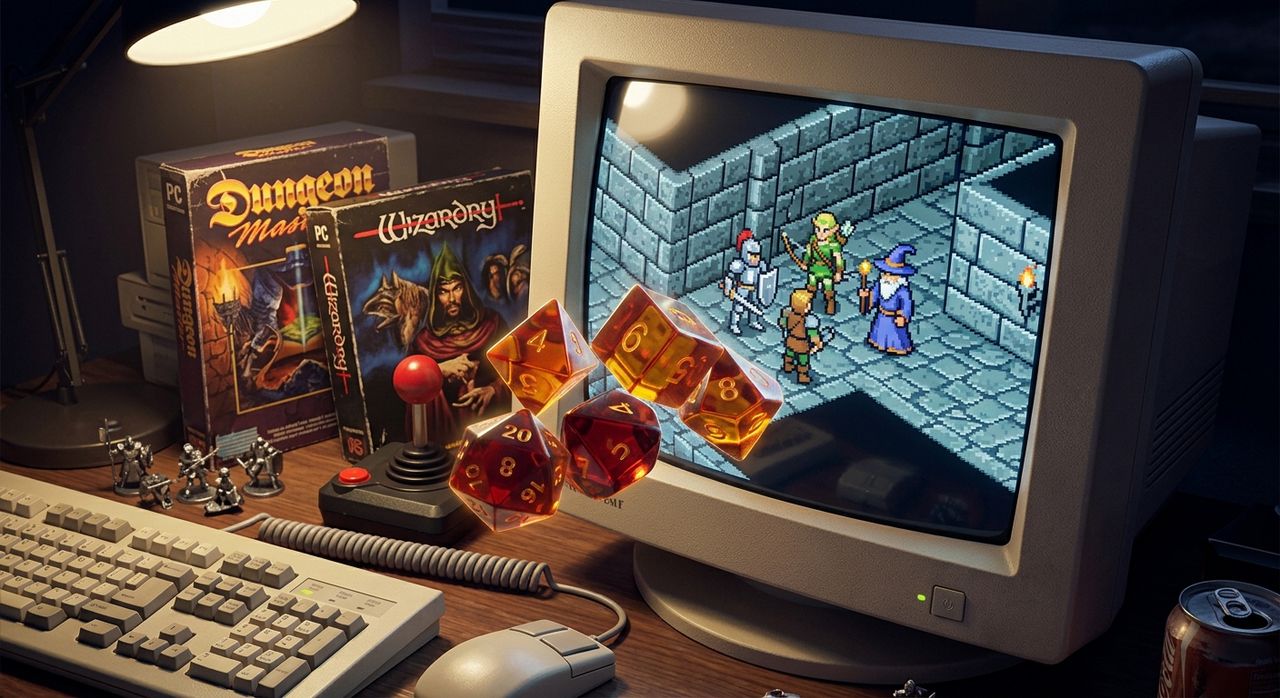
If you owned a PC in 1995, there was almost certainly a dice game hiding somewhere on the hard drive. Not as the main event. Not as something anyone discussed at work or school. It just lived there, tucked into a bundle folder alongside Solitaire and Minesweeper, waiting for a spare twenty minutes. That quiet audience turned into a genuine subculture, and the games that built it were more thoughtfully designed than most people realized at the time.
These games earned devoted followings not despite their simplicity, but because of the depth hidden underneath it.
- Bundled Yahtzee PC editions in the mid-90s introduced millions of players to scoring-based dice mechanics for the first time on a computer.
- Balut, a Manila-origin scoring variant, rewards multi-round strategic decision-making in a way that goes well beyond standard dice fare.
- Cross dominoes shares the same compact, high-replay quality that made retro gamers keep returning to these titles long after the novelty wore off.
The CD-ROM Bundle Era and the Games Nobody Expected to Love
The mid-1990s were the golden age of the bundle. Buy a new family computer from Packard Bell or Gateway, and a CD-ROM came with it, stuffed with software that ranged from genuinely useful to completely forgettable. Encyclopedia Britannica on disc. Paint programs that crashed on launch. Animated storybooks the kids tried once.
But buried in those compilations, usually near the back of the product sheet, was a small collection of board game and card game adaptations. Yahtzee was a regular fixture. So were variations of backgammon and solitaire. The developers behind these titles weren't large studios. They were small operations producing software for licensing deals or shareware distribution agreements. The shareware model of the era let players copy discs legally and pass them around, which meant a well-designed dice game could spread far beyond its original packaging.
The players who found these games were a specific type. Not the crowd chasing performance benchmarks in Quake or managing supply chains in Transport Tycoon. These were people who wanted something self-contained. A session with a clear endpoint. A game that started, played out, and finished in the time it took to drink a cup of coffee.
Dice games fit that need precisely. The rules were familiar. The sessions were short. And the decisions, surprisingly, mattered.
Why Yahtzee PC Editions Built Such a Durable Following
Yahtzee had been in living rooms since Milton Bradley released the physical version in the late 1950s. By the time PC adaptations arrived in the mid-90s, the rules were already embedded in popular culture. Roll five dice, keep what you want, reroll up to twice, assign your result to one of thirteen scoring categories. Simple to explain. Genuinely difficult to optimize.
Its scoring structure, particularly the bonus system for filling the upper section, rewarded players who understood basic probability without requiring any formal math knowledge. That's a rare balance in game design. It felt like skill. It rewarded attention and planning. But it also gave enough room for a lucky run to keep less experienced players engaged.
The PC version added something the physical game couldn't easily replicate: a patient, always-available opponent. You didn't need to convince anyone to sit down. You just double-clicked the icon.
Players who got hooked on the format often wanted something more demanding. Something that pushed the decision layer harder, asked more of your planning, and punished lazy rolls a little more directly.
Balut: The Game That Asked More of You
Balut came out of the Philippines, where it developed as a popular bar and street-side game before spreading through American military communities and eventually into casual gaming circles in the West. Its documented origins) in Filipino dice culture shaped the pacing of the whole experience. The game was designed for social play across multiple rounds, not for fast, disposable sessions.
The basic framework looks familiar. Five dice. Multiple rolls per turn. Scoring categories. But Balut gives you four rolls per turn instead of three, and the category structure runs across multiple separate rounds, each targeting a specific scoring category. That changes everything about how you think.
In standard Yahtzee, you're reacting to what you roll and finding the best place to score it. In Balut, you're committing to a category for the round before you see a single die. Then you're adapting within that commitment. When to hold two dice instead of four. When to take a zero and move on. Whether the round's target is worth chasing aggressively or managing conservatively.
That's genuine strategic depth. The kind that had retro PC gamers returning to a session, convinced they could optimize their approach if they just thought through it a little more carefully.
If you want to play Balut without hunting for a working Windows 95 disc, modern browser versions capture exactly what made the format compelling for that audience, with no installation required.
How Multi-Round Commitment Changes Everything
The structure Balut inherited from Filipino dice culture is the thing that separates it from lighter alternatives. You're not just maximizing a single scorecard. You're thinking across the arc of the full game, weighing what you've already locked in against what you still need. That longer-term planning is what the retro PC crowd responded to, even when they didn't have a name for it. They were drawn to games where decisions compounded.
Cross Dominoes and the Tile Game That Rewards Real Thinking
Dominoes as a PC game had always carried a structural problem. The standard draw game is built around social dynamics. Reading opponents. Managing your hand relative to what's visible on the table. Against a single computer opponent, some of that texture disappears, and the game can drag.
Cross dominoes changed the equation by changing the board. Instead of a single linear chain extending in two directions, tiles branch outward from the starting double in four directions simultaneously. That structural shift opens up more blocking angles, more placement decisions, and a more complex spatial puzzle with each turn.
This is exactly the kind of reasoning that PC gamers of the era brought to puzzle and strategy titles. You're not just matching pips and waiting for your next turn. You're reading a growing board, deciding which branches are worth extending and which ones you'd rather see close off. A single tile can affect four directions at once.
If you want to try cross dominoes in a format that respects the original strategic depth, modern browser versions handle the four-way layout cleanly and let you jump straight into the logic without any setup.
What This Audience Always Valued and Why These Games Delivered It
The dice and tile game community that grew out of the CD-ROM bundle era wasn't defined by nostalgia. It was defined by taste. Specifically, a taste for games that respected both your time and your intelligence simultaneously.
Here's what that audience consistently came back for:
- Sessions that fit into a real break with a clear start and a clear end, not a manufactured pause
- Rules simple enough to remember without a manual but deep enough to reward repeated play
- Scoring systems where every decision carried real weight
- Consistent opponents that played by the same rules you did, without feeling rigged
- Replayability that came from the game structure itself, not from unlockable modes or progression systems
Balut and cross dominoes both deliver on every point. That's not a coincidence. Both games were shaped by communities of players who played them seriously over long periods of time. The rules that survived that process are the rules that hold up.
Five Minutes to Start, Years to Walk Away From
The dice and tile games that built loyal PC followings in the 90s weren't accidents of distribution or packaging. They were the product of a specific creative constraint: build something genuinely compelling with almost nothing. No cutscenes. No voice acting. No world to render. Just rules, dice, tiles, and the decisions you make with them.
Balut asks you to plan across multiple rounds, manage commitments under uncertainty, and score as high as possible when the dice don't cooperate. Cross dominoes asks you to read a branching board and place every tile like the game depends on it, because sometimes it does.
Neither game pretends to be more than it is. That honesty is what the retro PC audience responded to then. It's still what they're responding to now.
Leave a Comment