
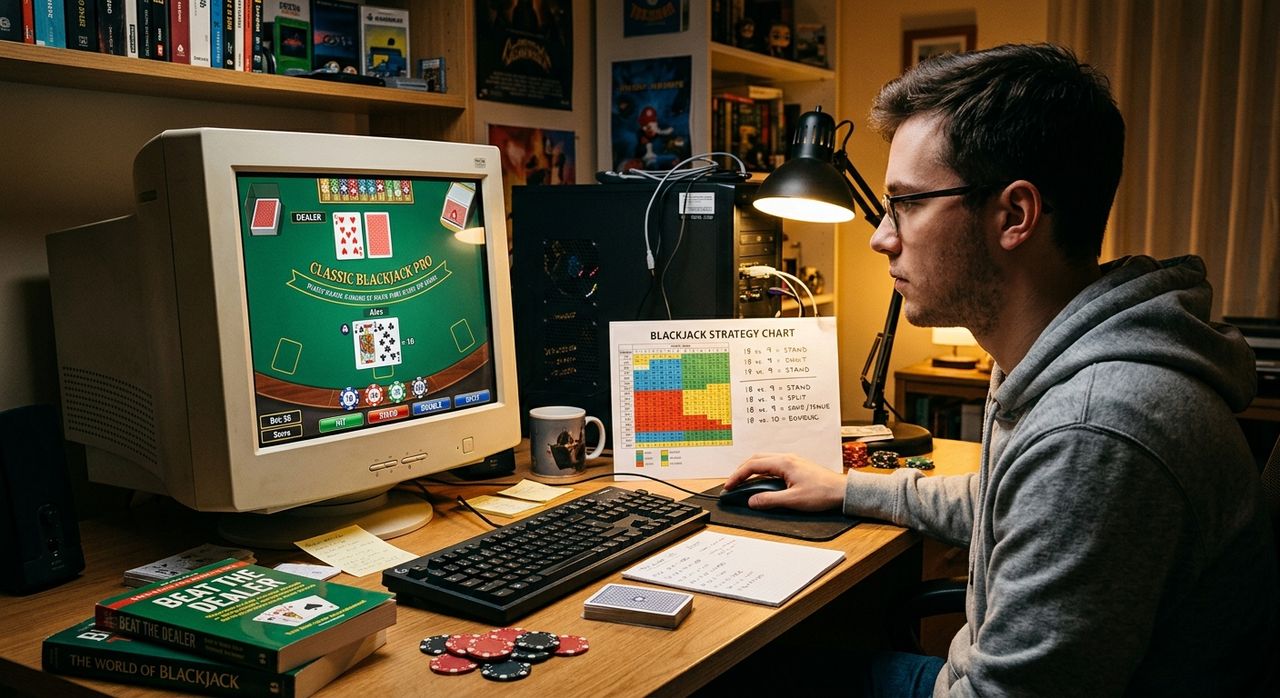
If you grew up playing Hoyle Casino or Microsoft Casino on a Windows 95 machine, you know exactly how it felt. The green felt, the pixel chip stacks, the satisfying rhythm of cards dealt at software speed. Those games were genuinely fun, and for millions of PC gamers they were the first real introduction to table-game mechanics. But here is what those titles almost never told you: the math behind every decision was right there, hiding in plain sight, and the games rarely acknowledged it.
Key Takeaway:
1. Classic casino PC titles introduced table-game mechanics to a generation but left out basic strategy entirely.
2. The basic strategy chart is the most important tool for any blackjack player, cutting the house edge to under 0.5 percent.
3. Variants like pontoon and beginner-friendly games like craps round out the casino knowledge from that same software era.
The Golden Age of PC Casino Software
Hoyle Casino launched in the early 1990s under Sierra On-Line and ran through many editions across the following decade. It featured blackjack, poker, roulette, and more, all wrapped in cheerful cartoon presentation. Microsoft Casino arrived a bit later and leaned harder into glossy realism for its time. Both titles were staples in the bargain bins at Walmart and Best Buy, and both ended up on a surprising number of family PCs.
What they had in common was approachability. You could sit down at the virtual blackjack table with zero prior knowledge and start playing in about thirty seconds. The rules appeared briefly on screen. The chips were easy to move. You could win or lose millions of virtual dollars over a rainy afternoon without any real consequence.
But there was a problem. Neither game ever paused mid-hand to explain why doubling down on a soft 18 against a dealer six is the mathematically correct move. You learned the rules. You did not learn the strategy.
What Those Games Actually Taught You
To be fair, Hoyle and Microsoft Casino were not useless as learning tools. They handled a few things genuinely well.
- They made players comfortable with hand values and basic card mechanics from the first session.
- They showed how the dealer behaves under house rules, standing on 17 and drawing to 16.
- They introduced splitting and doubling without making you read a rulebook first.
- They trained your sense of pacing, which matters more than people think when managing a session bankroll.
That exposure was real value. Many players walked away from those games knowing what a natural blackjack paid, knowing to skip insurance, and carrying a rough instinct for when to hit or stand. That is more foundation than most beginners bring to the table.
The problem appeared the moment real stakes entered the picture. Playing gut-feel blackjack can cost you an extra two to three percent in house edge compared to correct basic strategy. Over thousands of hands, that gap compounds into serious money.
The One Thing Those Games Glossed Over
Basic strategy is not complicated to use. It is a chart built from probability mathematics that tells you the optimal play for every possible hand combination, based on your total and the dealer's upcard. It was developed in the 1950s and has been refined many times since. According to established blackjack probability research, perfect basic strategy reduces the house edge to less than 0.5 percent in many standard rule sets.
That number matters. It means for every hundred dollars wagered, you are only expected to lose about fifty cents in the long run when you play every hand correctly. No other table game offers odds that tight when skill is involved.
The classic PC games never showed you this chart. They let you play freely, make whatever move felt right, and occasionally prompt you with a vague warning when you made an obvious error. They did not hand you the map.
If you want to fill that gap today, the best move is to play Blackjack with a strategy chart open beside you and use it for every decision, even the ones that feel obvious. After a few hundred hands, the correct moves start becoming instinct.
Here is a process that actually works for building that habit:
- Print or open a basic strategy chart and keep it visible while you play.
- Before each decision, check the chart even when you think you already know the answer.
- Note every moment your gut said one thing and the chart said another.
- After each session, review those moments and understand why the chart disagrees with intuition.
- Repeat this across several sessions before playing with any real money involved.
Pontoon and the Shareware Circuit
For UK gamers especially, Hoyle Casino was not the only option on the shelf. The shareware scene of the early 1990s produced a wave of casino compilations, and many of them featured pontoon alongside or instead of standard blackjack. The two games look similar from the outside but behave very differently once you sit down.
Pontoon is a British variant with a distinct set of rules. The dealer's cards are both face down, removing a key piece of information from your decision-making. You must buy or twist rather than double or hit. A five-card hand under 21 beats everything except a natural pontoon. These differences change your optimal play significantly, and applying a standard blackjack chart to pontoon will cost you.
Learning pontoon rules before sitting down matters because players who assume the variant plays like standard blackjack tend to make costly errors early. The doubling equivalent in pontoon, called buying, has its own conditions and restrictions. Research on pontoon's card game history) confirms it traditionally runs a higher house edge than blackjack when played without variant-specific strategy. Knowing which game you are actually playing is half the battle.
The Other Classic from the Software Catalog
Blackjack and pontoon were not the only table games showing up in those late 1990s software bundles. Craps was a staple too, and it has always carried a reputation for being the most intimidating game on any casino floor. The layout looks chaotic. The terminology sounds like a different language. Players are shouting things that make no sense to a newcomer.
The PC versions tried to soften that image with tutorials, but most players still bounced back to blackjack quickly. What those tutorials missed was a stripped-down entry point, a version of the game focused only on the bets that actually make sense for someone starting out.
If craps felt overwhelming in the Hoyle era, starting with simplified craps is a sensible approach today. You learn the pass line, the don't pass line, and basic odds before worrying about proposition bets that experienced players mostly ignore anyway. The same logic applies as it does with blackjack: learn the bets with the lowest house edge first, then branch out once the foundation is solid.
What the PC Gaming Era Got Right
The classic casino titles of the Windows era deserve more credit than they sometimes receive. They were a gateway, imperfect but genuinely effective.
- They normalized the idea that table games have rules worth understanding, not just mechanics worth clicking through.
- They made card games feel accessible and even social, by wrapping them in context and personality at a time when that was far from guaranteed.
The gap they left was not about effort or intent. The developers of Hoyle Casino and its competitors were making entertainment software, not teaching tools. The math behind optimal play was not their focus.
But the math is always the point if you want to play these games with any real competence. Basic strategy for blackjack, variant rules for pontoon, simplified bet structures for craps, these are the things those classic games gestured at without quite saying out loud.
From Pixel Chips to Real Understanding
The best tribute you can pay to those old PC casino titles is to carry the curiosity they sparked into actual game knowledge. They opened the door. The strategy charts, the variant rules, the probability math, those are what you find on the other side.
Load up a practice table, put a basic strategy chart next to your screen, and spend an afternoon the way you once spent afternoons with Hoyle Casino. Except this time, you will understand exactly why you are making each move. That is the version of casino gaming those classic titles always wanted to be, and now you can actually get there.
Leave a Comment