
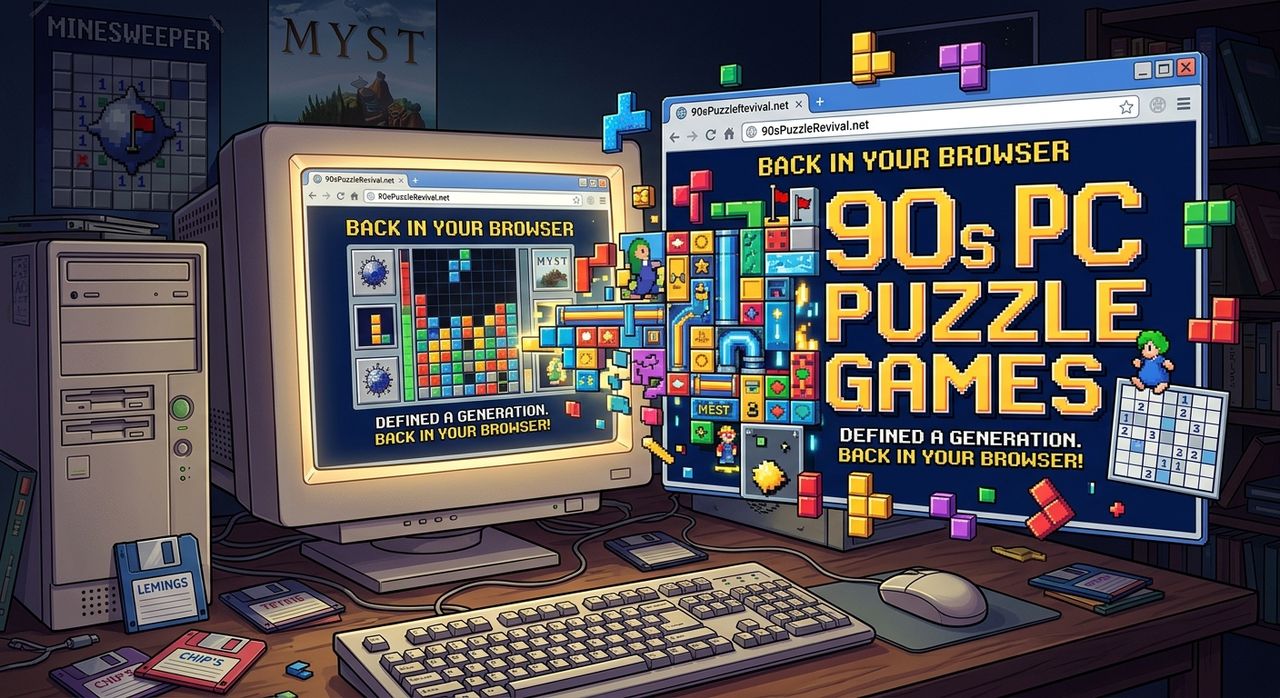
There was something almost meditative about sitting in front of a CRT monitor in 1993, cursor hovering over a cryptic symbol, the hum of a CD-ROM drive filling the room. Puzzle games on PC weren't just entertainment back then. They were a whole mood. They demanded patience, observation, and the kind of quiet focus that made hours vanish without warning. That tradition, born on floppy disks and shiny silver discs, never actually died. It just moved somewhere new.
Key Takeaway:
- The 90s PC puzzle genre produced some of the most influential games in history, from Myst and The 7th Guest to countless shareware logic titles
- Spatial reasoning and sliding-block puzzles were a staple of the era, rewarding methodical thinking over raw reflexes
- Many of the core mechanics from that golden age have been preserved and adapted for modern browser play
- Rush Hour, one of the most beloved spatial puzzlers of the era, has a direct lineage to the logic traditions of 90s PC gaming
- You can experience that same satisfying, deliberate challenge right now without installing a single file
When CD-ROMs Changed the Puzzle Game Forever
Before Myst arrived in 1993, puzzle games existed mostly as text adventures or simple tile-based diversions. Then suddenly, the medium exploded. Cyan Worlds showed the world that a puzzle game could feel like stepping inside a painting. The environments were richly rendered pre-calculated images. The puzzles were woven into the world itself. Players didn't fight enemies. They just thought. And millions of people were completely hooked.
Myst became the best-selling PC game of its era for a reason, and it wasn't luck. The game understood something important: puzzles feel most satisfying when they feel earned. When the solution clicks into place, when you finally understand the logic you've been staring at for 20 minutes, that moment of clarity is genuinely rewarding. That's not a dated feeling. That's human nature.
The 7th Guest followed a similar path, combining full-motion video with brain-teasing logic puzzles inside a haunted mansion. These weren't action games dressed up as puzzles. The puzzle was the entire point.
Shareware Disks and the Logic Puzzle Boom
Not everyone had a CD-ROM drive in 1993. For a huge portion of the PC gaming audience, the puzzle scene lived on floppy disks and shareware compilations. If you were a kid in the early 90s and your family owned a PC, you almost certainly played something off a shareware disk, whether you knew it by that name or not.
Those disks were stuffed with logic games. Sliding-block puzzles. Sokoban clones. Tile-matching games. Maze navigators. The variety was wild, and the quality varied just as much, but the good ones shared common DNA with the bigger commercial releases. They were built on spatial reasoning. They asked you to hold a mental map of the puzzle and think several moves ahead.
Here's what made that era of puzzle gaming so distinctive:
- Games rewarded patience over speed, prioritizing logical thinking above all else
- Most titles had no tutorials, trusting players to work things out through observation
- Difficulty scaled naturally as players internalized the rules over time
- Replayability came from attacking levels more efficiently on repeat runs
- The puzzle was self-contained, requiring no story scaffolding to justify the challenge
That last point matters more than it sounds. A great spatial puzzle doesn't need narrative crutches. The problem itself carries all the weight. You understand what needs to happen. The question is whether you can figure out how.
The Mechanics That Kept 90s Players Glued to Their Screens
Sliding-block puzzles are older than video games by nearly a century. They trace back to the 1870s and the classic 15-puzzle, where 15 numbered tiles sit in a 4x4 grid with one empty space, and the goal is to slide them into order. Simple concept, genuinely tricky execution.
What the 90s PC era did was take that foundational mechanic and dress it in dozens of different costumes. You moved crates in Sokoban. You rearranged pipes. You rotated tiles to complete an electrical circuit. The core challenge, moving objects through constrained space according to strict rules, was identical in almost every case. The presentation changed. The appeal didn't.
Spatial reasoning stuck around as a puzzle mechanic because it maps to something people find deeply satisfying. There's a pleasure in holding a complex arrangement in your mind, predicting how a move will cascade through the whole system, and then executing it correctly. It feels like thinking well. No other genre replicates that sensation in quite the same way.
How the Browser Became the New Shareware Disk
For about a decade, the puzzle genre lost some of its footing on PC. The 2000s were dominated by action games and shooters. Puzzle games still existed, but they were often relegated to casual portals and treated as filler rather than legitimate challenges.
Then something interesting happened. Mobile gaming arrived, and suddenly puzzle mechanics were everywhere again. The tile-matching logic that shareware games used in 1994 powered massively popular mobile titles. Spatial puzzle traditions from the 90s showed up in award-winning mobile games. The genre hadn't disappeared. It had been waiting.
Browser games picked up a similar thread. Unlike app stores, which fragment the audience across platforms and payment barriers, the browser is universal. It's the modern equivalent of a shareware disk. Anyone can play. Nothing needs installing. The barrier is zero, and that accessibility is exactly why the best browser puzzle games feel so familiar to anyone who grew up on 90s PC gaming. Open the tab. Start the puzzle. That's it.
Rush Hour: Where 90s Spatial Logic Lives On
Rush Hour as a puzzle concept predates even the CD-ROM era. The physical board game, designed by Nob Yoshigahara, was first manufactured in the late 1970s. But it found a massive audience in the 90s and early 2000s, precisely because its mechanics aligned perfectly with the spatial reasoning tradition that PC puzzle games had made mainstream.
The challenge is elegantly simple. A red car needs to exit a crowded grid. Other vehicles block the way. You can slide them forward or backward, but not sideways. Every vehicle has a fixed orientation. You have to clear a path, one careful move at a time.
What makes it compelling isn't the concept. It's the constraint. Every vehicle you move affects every other vehicle. A move that opens one path might close another entirely. You have to think ahead, visualize the board state several moves into the future, and work backward from where you need to be. That's exactly the same cognitive demand that Myst made, that Sokoban made, that every great 90s puzzle game made.
The rush hour puzzle available in the browser now captures all of that without any friction. The controls are immediate. The levels range from genuinely straightforward to satisfyingly tricky. And the mechanical satisfaction, that click when you finally see the solution, is completely intact.
That matters, because a lot of browser adaptations of classic puzzle concepts lose something in translation. They add unnecessary timers. They pile on cosmetic noise. They simplify the challenge in the name of accessibility, and in doing so, strip out the very thing that made the original worth playing. This format holds onto the substance. The grid is clean. The rules are clear. The difficulty is real.
What the 90s Got Right About Puzzle Design
There's a reason people still talk about Myst and The 7th Guest while similar games from that era have been completely forgotten. Those titles had a design philosophy that respected the player's intelligence. They assumed you could figure things out. They didn't hold your hand. They presented you with a problem and trusted you to meet it.
Good puzzle design hasn't changed since then. The principles are the same:
- A clear goal that players grasp immediately without explanation
- Rules simple enough to learn but rich enough to generate genuinely complex situations
- Solutions that feel logical in retrospect, never arbitrary or unfair
- A difficulty curve that teaches through play rather than through text prompts
- Enough variation in layout to keep the core mechanic feeling fresh across many levels
Rush Hour checks every one of those boxes. Myst checked them. The best shareware logic puzzles checked them. That consistency across decades and formats isn't coincidence. These are durable design principles that keep producing games people actually want to finish.
The CRT Glow Lives On in Your Browser Tab
The puzzle games that defined 90s PC gaming were never really about the technology. The CD-ROM was a delivery mechanism. The CRT monitor was just a display. What mattered was the thinking, the quiet satisfaction of working through a spatial problem until the solution revealed itself.
That experience is still available. Right now, in a browser tab, you can sit down with the same kind of deliberate, methodical puzzle challenge that kept people in front of their monitors for hours in 1994. The screen has changed. The impulse hasn't.
If you grew up on shareware puzzle disks or spent entire afternoons in the world of Myst, the browser puzzle scene is worth your time. The genre held its ground through decades of shifting trends. And some of the best examples of it feel less like new games and more like reunions with an old friend who has picked up a few new tricks along the way.
Leave a Comment